

You’re looking for a Shopify alternative because your monthly bill keeps climbing with every app you add, or because you’re frustrated by building a business inside an ecosystem whose costs you can’t fully predict. You’re not alone.
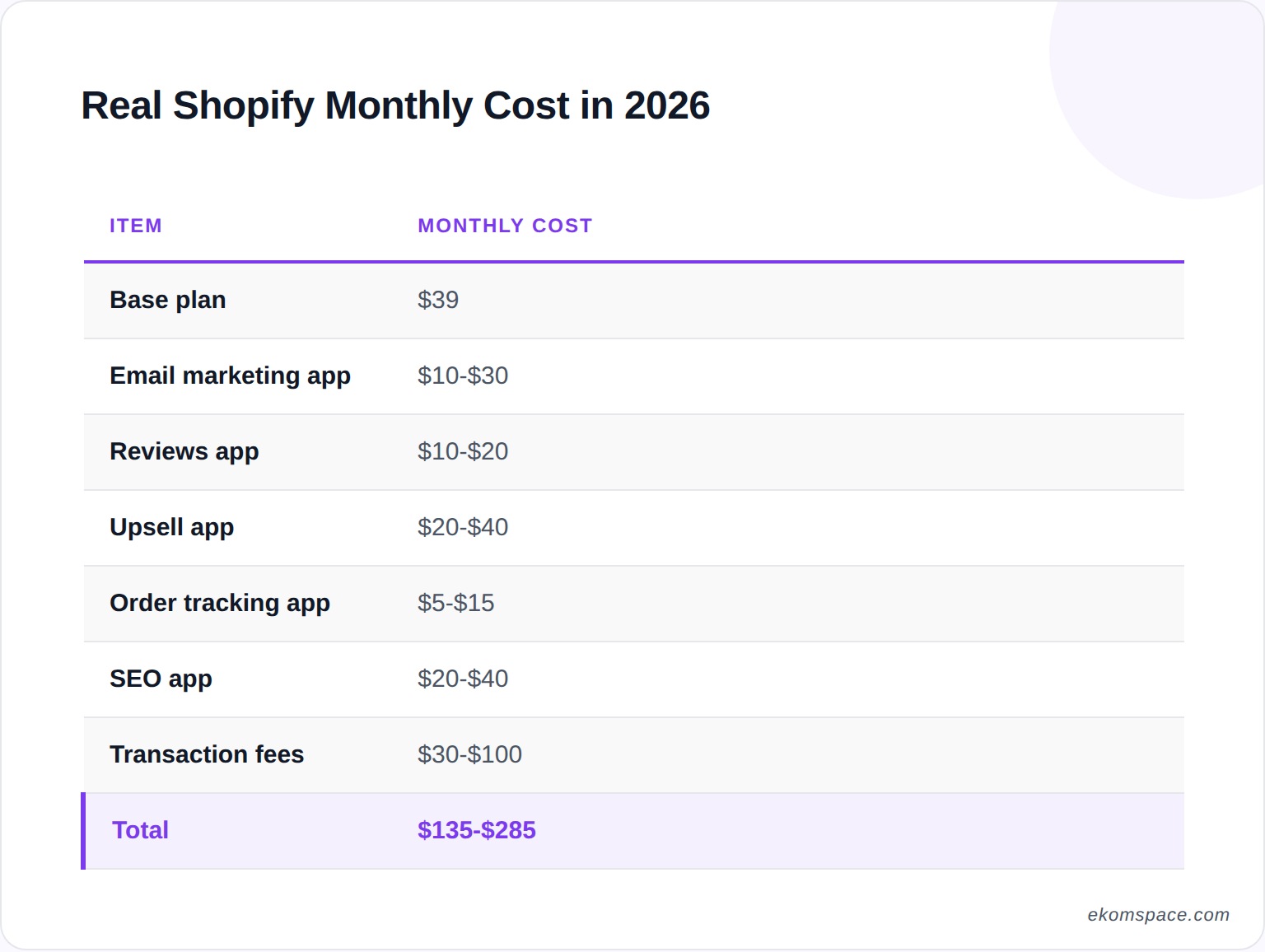
Every month, merchants across the US, UK, Australia, Canada, India, the Philippines, Nigeria, South Africa, Singapore, the UAE, and dozens of other markets come to the same realization: Shopify’s $39/month base plan is just the beginning of what you’ll actually spend. Add email marketing, customer reviews, upsells, an SEO tool, and order tracking — none of which Shopify includes natively — and that $39 can quietly become $150, $200, or more each month before you’ve hit your stride.
This guide compares seven platforms honestly: Ekomspace, WooCommerce, Wix, Squarespace, PrestaShop, BigCommerce, and Shopify as the reference point. You’ll find real prices (apps and commissions included), verified user reviews from Trustpilot, a step-by-step migration checklist, and a clear decision guide — including an honest look at when staying on Shopify still makes sense.
TL;DR: If you want a Shopify alternative where email marketing, customer reviews, one-click upsells, SEO, and an AI customer service agent are all built in — no extra apps, no surprise bills — Ekomspace delivers all of that in one subscription starting at €39/month. If you need maximum flexibility and have technical resources, WooCommerce is worth considering. For high-volume sellers with zero tolerance for platform fees, BigCommerce is a strong pick. The full breakdown follows.
1. Why Merchants Actually Leave Shopify
The short answer: Shopify’s real cost isn’t the subscription — it’s what you pay on top of it.
Shopify was founded in 2006 by Tobias Lütke, Daniel Weinand, and Scott Lake, originally to solve their own problem selling snowboard equipment online. Today it powers millions of merchants in over 175 countries. It is a genuinely capable platform. But it has a well-documented friction point that keeps coming up: the gap between the advertised subscription price and what you actually end up paying.
Pain point #1: Essential features that require paid apps
Shopify’s App Store now has approximately 31,000 active public apps (as of October 2026). But browsing that app store is what you have to do just to reach a functional baseline — features that many competing platforms include by default:
- Email marketing — not included natively; most merchants use Klaviyo, Omnisend, or Shopify Email
- Customer reviews — requires Judge.me, Loox, Yotpo, or similar
- One-click upsells — requires ReConvert, Zipify, or AfterSell
- Order tracking — requires AfterShip, Parcel Panel, or similar
- Advanced SEO tools — requires dedicated apps
Each of these typically costs $15–$50/month. Stack five of them and your “basic” store that looked like $39/month is running closer to $150–$200/month — before transaction fees.
Pain point #2: Transaction fees when you don’t use Shopify Payments
Shopify Payments is only available in approximately 41 countries. If you’re in India, Nigeria, Kenya, Ghana, the UAE, most of Latin America, or large parts of Africa, you’ll need a third-party gateway like Stripe or PayPal instead — and Shopify charges an additional fee on every sale:
- Basic plan: 2% per transaction
- Grow plan: 1% per transaction
- Advanced plan: 0.6% per transaction
- Plus plan: 0.2% per transaction
These fees stack on top of your payment processor’s own rates (Stripe charges around 2.9% + $0.30 in the US). On $10,000/month of sales through Shopify Basic with a third-party gateway, Shopify takes $200 from you before Stripe gets their cut.
Merchants have noticed. Here are three verified reviews from Trustpilot:
“Shopify’s shameless cash grab, announced 10 days before Black Friday.”
— Ben, Trustpilot (source)
“It took THREE HOURS to cancel a $39 monthly subscription.”
— Gary, Trustpilot (source)
“My store has functioned properly only about one-third of the time.”
— Ruth, Trustpilot (source)
This doesn’t make Shopify a bad platform — far from it. But it explains why the search for a Shopify alternative is growing every year.
2. Shopify Alternatives at a Glance: Comparison Table (November 2026)
This table shows the entry price, platform transaction fees, and best use case for each of the seven platforms covered in this guide. Detailed sections for each follow below.
| Platform | Entry Price | Platform Fee | Payment Methods | Features Built In | Best For |
|---|---|---|---|---|---|
| Shopify (reference) | $39/mo (or $29/mo annual) | 0.6–2% (without Shopify Payments) | Shopify Payments (~41 countries), Stripe, PayPal | No — paid App Store | Established merchants, large app ecosystem |
| Ekomspace | €39/mo | 2% / 1% / 0.5% | Stripe, PayPal, Apple Pay, Google Pay, Klarna, COD | Yes — everything native | All-in-one, fast launch, no app bills |
| WooCommerce | Hosting: $25–$350/mo | 0% | WooPayments, Stripe, PayPal, and dozens of other gateways | No — paid extensions | Technical teams, full control |
| Wix | $17/mo (annual) | 0% | Wix Payments, PayPal, Stripe | Partially | Beginners, creative small businesses |
| Squarespace | $17/mo (annual) | 0% | Squarespace Payments, Stripe, PayPal | Partially | Design-first brands, services + products |
| PrestaShop | Hosting + modules | 0% | Stripe, PayPal, Klarna, 100+ | No — paid modules | Complex stores, technical teams |
| BigCommerce | ~$29/mo (annual) | 0% | 65+ payment providers | Partially | High-volume sellers, B2B |
Ekomspace prices are in EUR. All other prices are in USD. Prices as of November 2026.
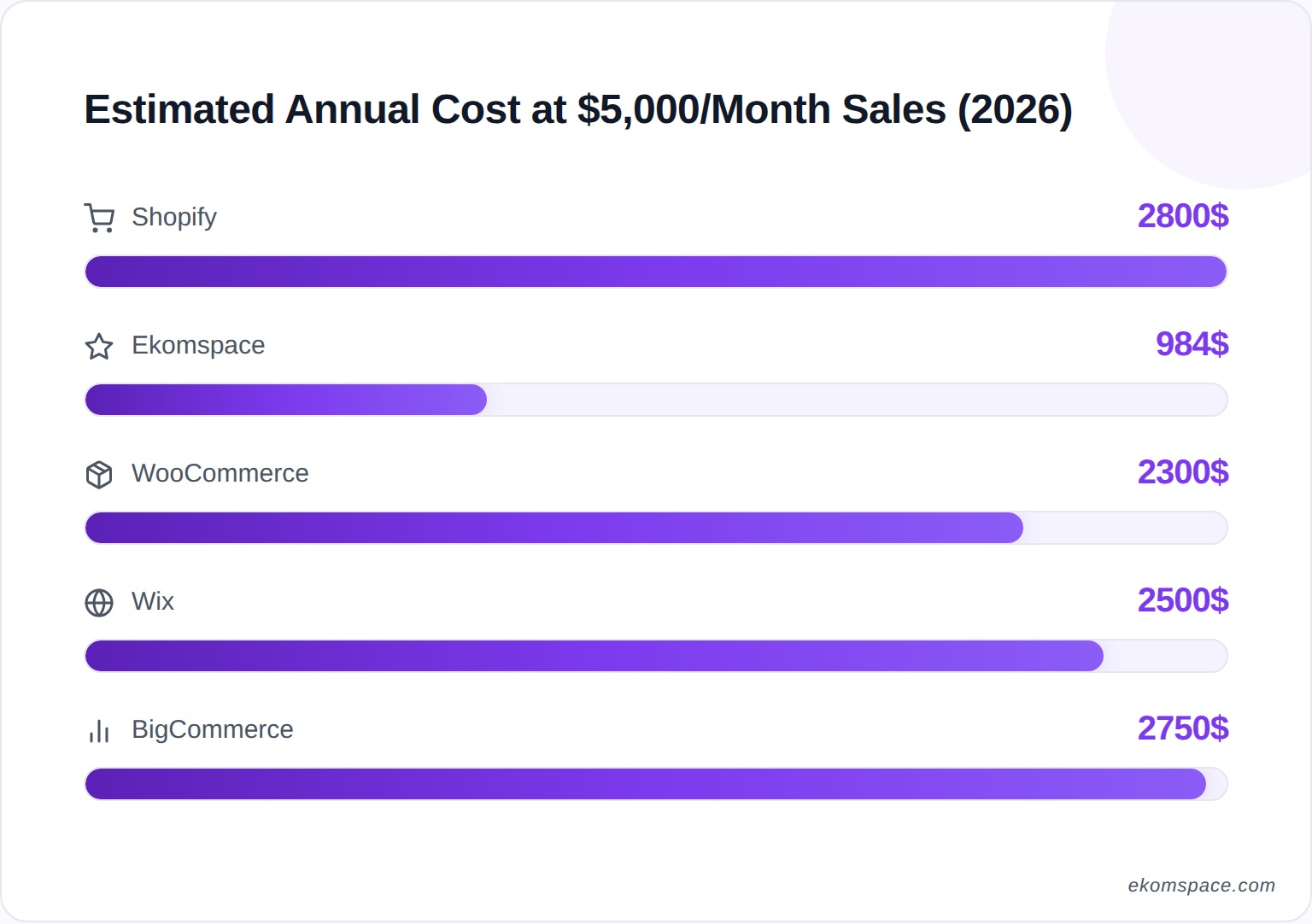
What this table doesn’t show: WooCommerce’s $0 sticker price becomes $300–$800+/year once you add hosting and extensions. PrestaShop is similar. And Ekomspace’s 2% platform fee (Starter plan) adds up at higher volumes — but every app you’d normally pay extra for is already included. The right comparison is always total cost over 12 months, apps and commissions included.
3. Ekomspace: Best All-in-One Shopify Alternative
Best for: merchants who want every essential e-commerce feature in one subscription — no app store, no surprise bills, no third-party tools to manage.
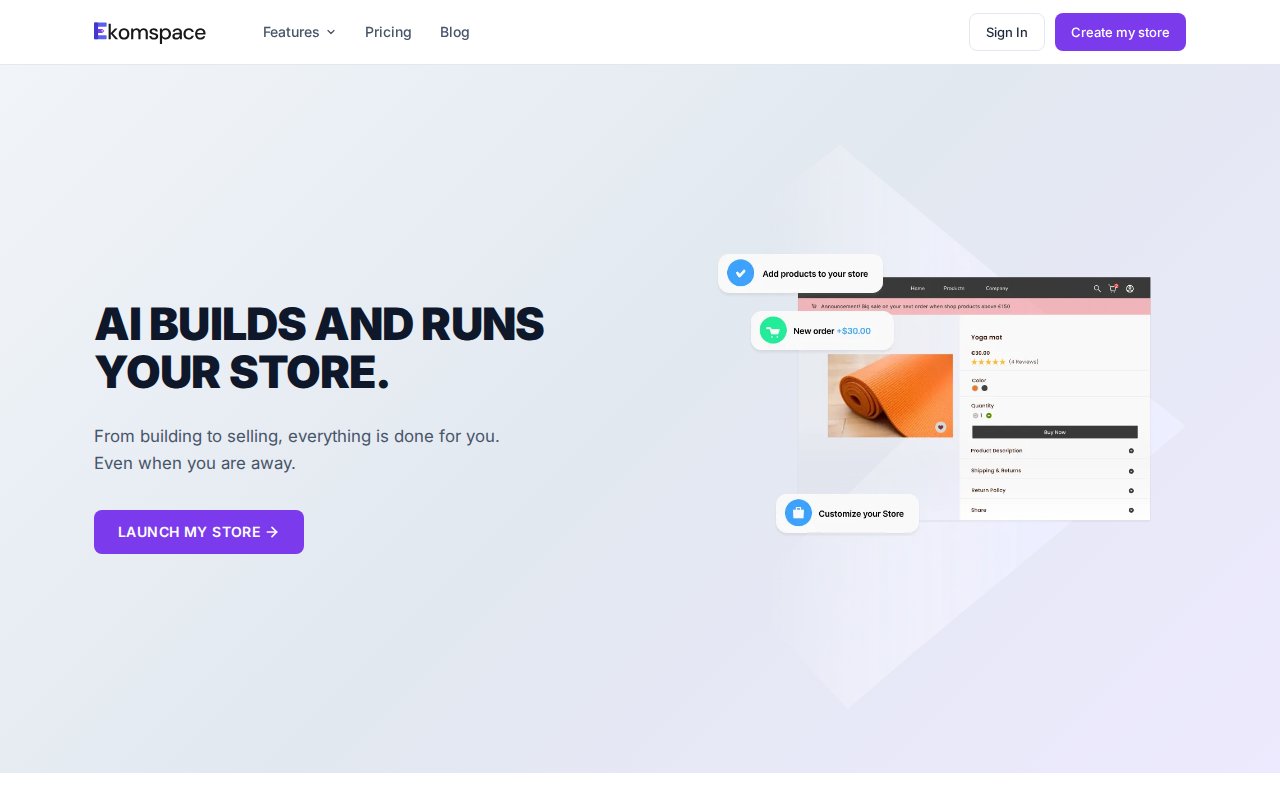 Ekomspace homepage — the AI creates and runs your store end-to-end.
Ekomspace is a SaaS e-commerce platform built around AI agents: one builds your store from a plain-text description, one writes SEO blog content daily, one handles customer service on your storefront around the clock, and one manages your email marketing — all without you installing a single external app.
Ekomspace doesn’t just build your store. Its AI agents keep working after launch to generate sales: writing daily content, responding to customer inquiries, and running your marketing. That is the core difference from a traditional e-commerce builder.
Everything included natively — no app store
Here is what every Ekomspace plan includes from day one, with nothing extra to subscribe to:
- Email marketing (built in-house — not Klaviyo, not Omnisend, not Brevo): full campaigns, transactional emails, automations (abandoned cart, site visit, welcome series), and AI-generated templates you can edit or regenerate
- Customer reviews: collect, manage, and display reviews — the equivalent of Judge.me or Loox, included at no extra cost
- One-click upsells and order bumps: increase average order value without paying for ReConvert or AfterSell
- Native SEO: meta tags, automatic sitemap, schema markup, image optimization, speed optimization — a genuine platform strength
- AI customer service agent: a chat bubble on your storefront that responds to customers 24/7, handles “where’s my order?” queries using built-in parcel tracking, and escalates to a human via the Ekomspace mobile app (1 credit per resolved reply)
- AI blog agent: writes SEO articles every day according to a defined content strategy, targeting both Google and AI-powered search engines
- Parcel tracking: built in natively — no AfterShip or Parcel Panel required
- Affiliate system: fully featured, included in the subscription
- Google Shopping feed, Meta pixel (+ server-side Conversions API), TikTok pixel, GA4 — all included
- GDPR cookie banner, auto-generated legal pages, email capture popups with automation sequences
- Advanced page builder: the AI generates and modifies your storefront based on your instructions, with pre-defined styles (Minimal, Atelier, Volt, Terracotta, Lab, Heritage), AI-generated product descriptions, and AI image generation
- One-page checkout, fully customizable via the page builder; bundles, volume discounts, and cart drawer included
- Multi-currency: all currencies, on all stores
- AliExpress connection: import products and place semi-automatic orders (transmitted to AliExpress; you confirm payment with your card)
- 24/7 support: WhatsApp and chat on every plan — Starter, Pro, and Business all get the same level of support
Payments accepted: Stripe, PayPal, Apple Pay, Google Pay, Klarna, and cash on delivery (COD). Ekomspace does not have its own payment processing solution — standard processor rates apply on top of the platform fee. For merchants in markets where Stripe is not yet available (parts of West Africa, some Caribbean countries), verify local gateway availability before migrating.
Plans and real pricing
| Plan | Monthly (no commitment) | Monthly (12-month billing) | Platform fee | Products | Contacts |
|---|---|---|---|---|---|
| Starter | €39/mo | €32/mo | 2% | 500 | 2,000 |
| Pro (recommended) | €99/mo | €82/mo | 1% | Unlimited | 10,000 |
| Business | €299/mo | €249/mo | 0.5% | Unlimited | Unlimited |
The 24-month billing option brings the Starter plan to €29/mo, Pro to €75/mo, and Business to €225/mo.
How the platform fee works: the 2% / 1% / 0.5% fee applies to all sales and is added on top of your payment processor’s own fees. This is structurally similar to what Shopify charges when you’re not using Shopify Payments — with the key difference that Ekomspace already includes the email marketing, reviews, upsells, and SEO tools you’d otherwise pay for separately.
Each plan includes a monthly allocation of free AI credits (Starter: 20 credits; Pro: 50 credits; Business: 150 credits). AI actions consume credits — generating an image costs 0.5 credits, writing a meta description costs 0.1 credits. When your monthly credits run out, additional credits can be purchased from the Ekomspace credit store.
There is no free trial. Payment is by credit card. On the monthly plan, there is no commitment — cancel at any time. With a 12-month plan you get 2 months free; with 24 months, 6 months free.
Use code WELCOME for your first month at €1, then €39/month with no commitment. Valid on all monthly plans; not applicable to 12- or 24-month billing.
A few honest limitations to flag: each account supports one store; each store operates in one language (you can build in any language, but one domain = one language, by design); there is no App Store — this is a deliberate product choice; and purchasing a domain directly from Ekomspace is coming soon but is not yet available. You can connect a domain you already own with no friction.
Migrating from Shopify to Ekomspace
Migration is included in your subscription. Two methods:
- Paste your Shopify store URL — products, variants, collections, images, blog posts, and pages are imported automatically.
- Upload a CSV file — for customers and orders not covered by the URL import.
301 redirects are managed automatically — your old Shopify URLs redirect to the new ones, preserving your accumulated SEO equity. The entire process takes less than a day.
Plan note: migration is included at no extra cost on Pro and Business plans. On Starter, it is included with 12-month or 24-month billing.
Your store, built and run by AI
Describe your store: the AI builds it, then handles your emails, upsells, SEO and customer service. Everything is included from €39/month.
4. WooCommerce: Best Shopify Alternative for Technical Teams
Best for: merchants with developer resources or agency support who need maximum customization, full ownership of their data, and 0% platform transaction fees.
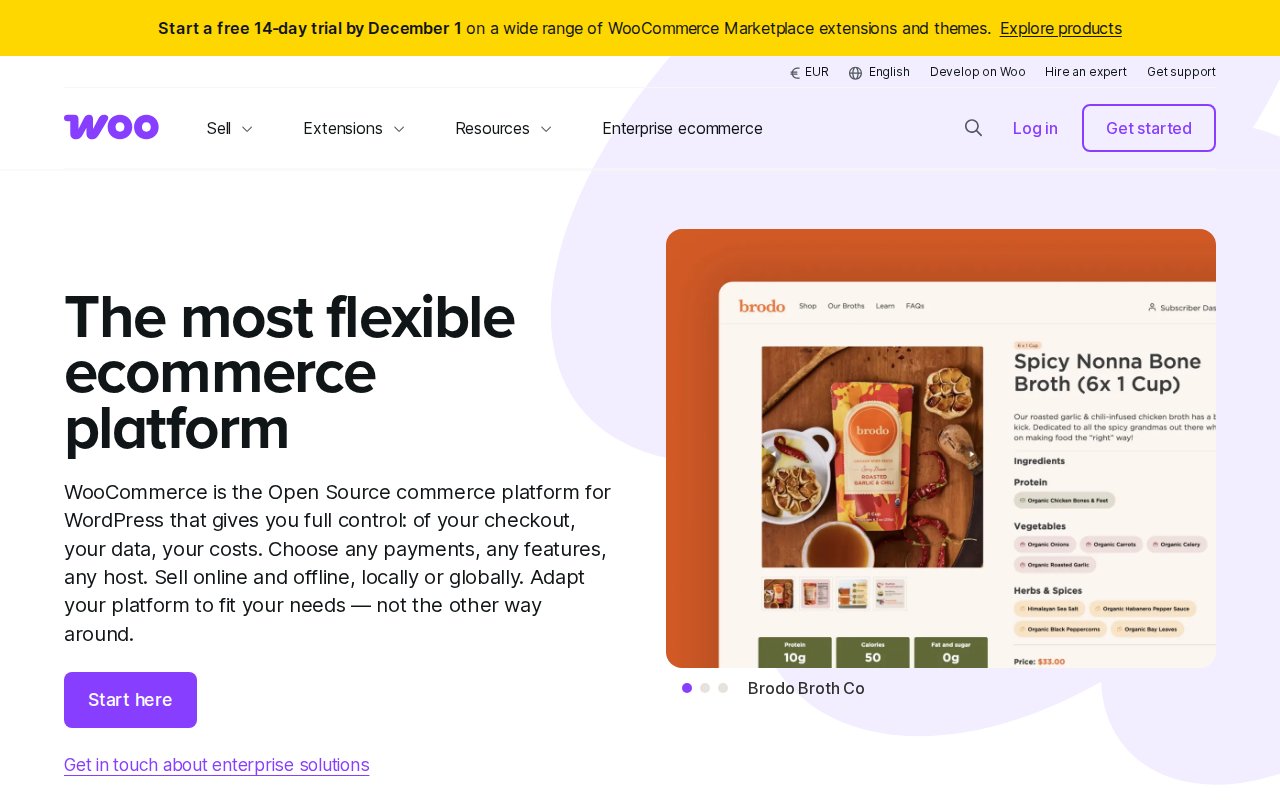 WooCommerce homepage — presenting itself as the most flexible e-commerce platform.
WooCommerce is an open-source plugin for WordPress, maintained by Automattic. It was originally created by WooThemes in 2011 and acquired by Automattic in 2015 for over $30 million. The core plugin is free and charges 0% platform transaction fees.
The real cost behind the “free” label
The WooCommerce plugin costs nothing — but here is what your monthly bill actually includes:
- Hosting: $25–$350/month depending on your solution. Popular managed WordPress hosts include Kinsta, WP Engine, and SiteGround; budget-friendly shared options include Bluehost and Namecheap.
- Extensions: every added feature — subscriptions, advanced product filtering, customer reviews, email marketing, SEO enhancements — is a separate purchase at $29–$299/year per extension.
- Payment processing via WooPayments: approximately 2.5–2.9% + $0.30 per transaction. Stripe, PayPal, Square, and hundreds of local gateways (including Razorpay for India, Paystack for Nigeria/Kenya/Ghana, and Paymongo for the Philippines) integrate natively.
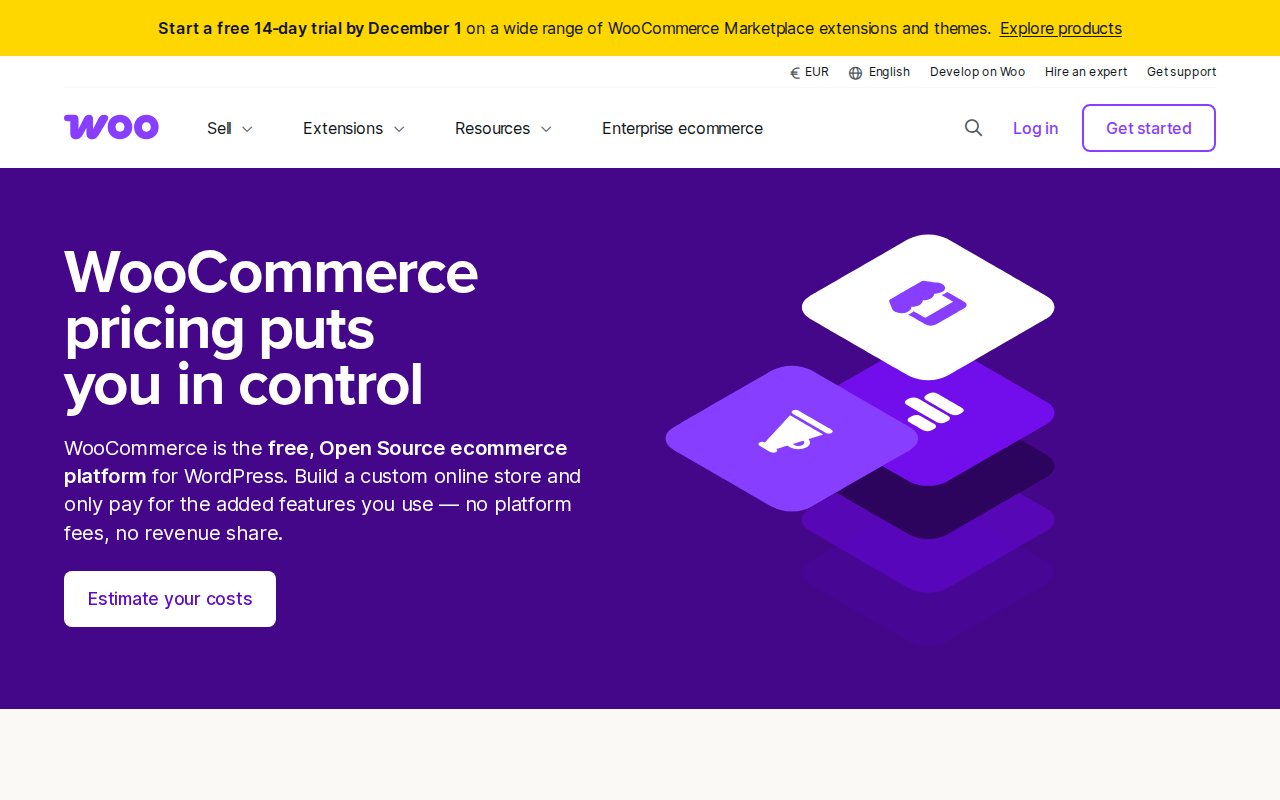 WooCommerce’s pricing page — the core is free, but essential functionality adds up fast.
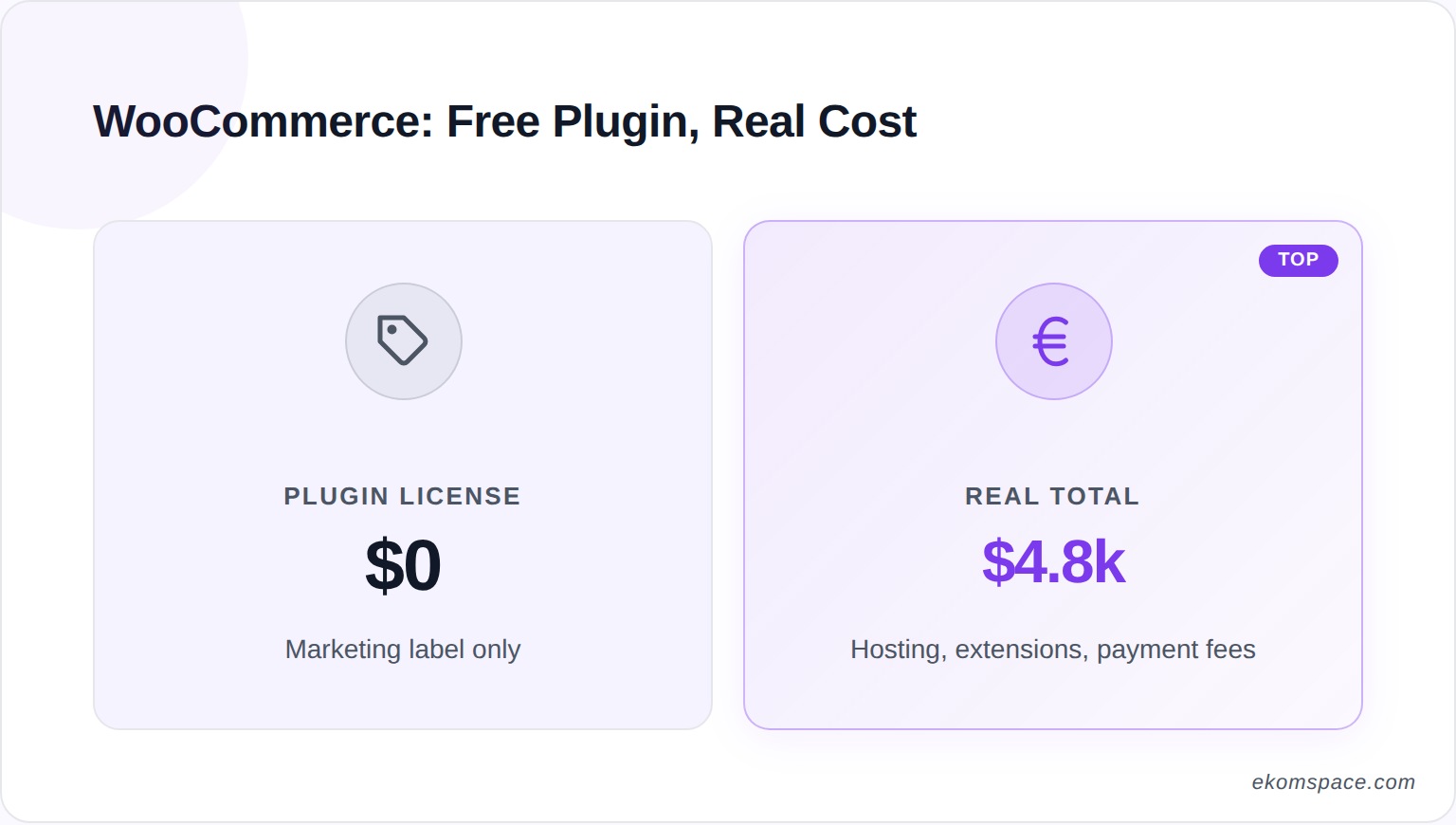 Realistic annual cost for a standard WooCommerce store: $300–$800+, excluding developer time for setup and maintenance. That said, for technically resourced teams, WooCommerce provides a level of control over checkout flows, pricing logic, data ownership, and local regulation compliance that SaaS platforms cannot match.
What real users say
“WARNING: Do Not Trust WooCommerce With Your Money ⚠️ My Experience: WooCommerce has taken payments from my customers, then reduced or withheld those funds without any explanation.”
— Jo, Trustpilot (October 7, 2026) (source)
“I never got to launch my shop. Eventually, I decided to delete everything and move to SureCart, where the process has been much smoother and simpler.”
— Angie, Trustpilot (August 7, 2026) (source)
Pros and cons
Pros:
- 0% platform transaction fees
- Complete ownership of your data and infrastructure
- Vast ecosystem of extensions, themes, and global developers
- Self-hosted: strong option for businesses with data sovereignty or compliance requirements (GDPR, HIPAA)
- Payment gateway ecosystem covers virtually every market globally
Cons:
- Real cost is $300–$800+/year, not “free”
- Steep learning curve for non-technical users
- Hosting, security, updates, and backups are entirely your responsibility
- Support quality varies by hosting provider and plugin combination
WooCommerce works best for merchants with in-house development resources or a trusted agency, complex catalog or pricing requirements, or businesses already operating on a WordPress stack. It is not a good fit if you want to launch quickly without technical help or need a predictable, all-inclusive monthly cost.
5. Wix eCommerce: Best Shopify Alternative for Beginners
Best for: first-time store owners, freelancers, and small businesses that want an easy drag-and-drop setup with a polished result — without a complex catalog or deep automation requirements.
 Wix homepage — positioning around Wix Harmony, its AI-powered website builder.
Wix was founded in 2006 by Avishai Abrahami, Nadav Abrahami, and Giora Kaplan. Its drag-and-drop editor is one of the most intuitive in the market, and Wix Stores — the e-commerce module — has expanded significantly in recent years, with 80+ payment options and a growing suite of built-in marketing tools.
Plans and pricing (annual billing, USD):
| Plan | Monthly price | Platform fee |
|---|---|---|
| Light | $17/mo | 0% |
| Core | $29/mo | 0% |
| Business | $39/mo | 0% |
| Business Elite | $159/mo | 0% |
Wix charges 0% platform transaction fees. Payment processing rates depend on Wix Payments or your chosen gateway.
Strengths:
- Genuinely beginner-friendly — no coding required
- Over 2,000 design templates
- Wix Harmony (powered by the Aria AI agent) for fast site setup
- 0% platform transaction fees across all plans
- Hosting included
Limitations:
- Advanced automation, subscription products, and deep multichannel selling may require paid apps at higher growth stages
- Switching templates after launch requires rebuilding sections
- Performance and SEO can lag behind dedicated e-commerce platforms at scale
What real users say
“Fantastic experience with Wix — I’ve built my business website, TheCar-Spa.co.uk, using Wix and honestly couldn’t be happier with the results. Wix has given me the tools to create a professional-looking website that I’m genuinely proud of.”
— The, Trustpilot (November 27, 2026) (source)
“Wix recently made a completely idiotic change. Newly added products now appear at the very bottom of my online store’s catalog instead of at the top, where my regular customers can easily see what’s new. With hundreds of products in my store, dragging every new item from the bottom to the top is a ridiculous waste of time. I wouldn’t recommend Wix to anyone, and I’ll be moving my store to another platform.”
— Maciej, Trustpilot (November 25, 2026) (source)
Wix is a solid Shopify alternative for small businesses that want a polished, low-maintenance storefront. If your store grows significantly in volume or catalog complexity, you may find yourself hitting its ceiling.
6. Squarespace: Best Shopify Alternative for Design-Led Brands
Best for: brands where aesthetics are core to the customer experience — independent fashion labels, photographers selling prints, studios, service businesses with an online store component.
Squarespace was launched in 2003 by Anthony Casalena from his university dormitory with a $30,000 loan from his father. It has grown into one of the most design-focused website builders available, and its commerce module has steadily matured over the years to support products, services, memberships, and scheduling.
Plans and pricing (annual billing, USD):
| Plan | Monthly price | Platform fee |
|---|---|---|
| Basic | $17/mo | 0% |
| Core | $24/mo (recommended) | 0% |
| Plus | $42/mo | 0% |
| Advanced | $79/mo | 0% |
Squarespace offers a 14-day free trial. There is no permanent free plan.
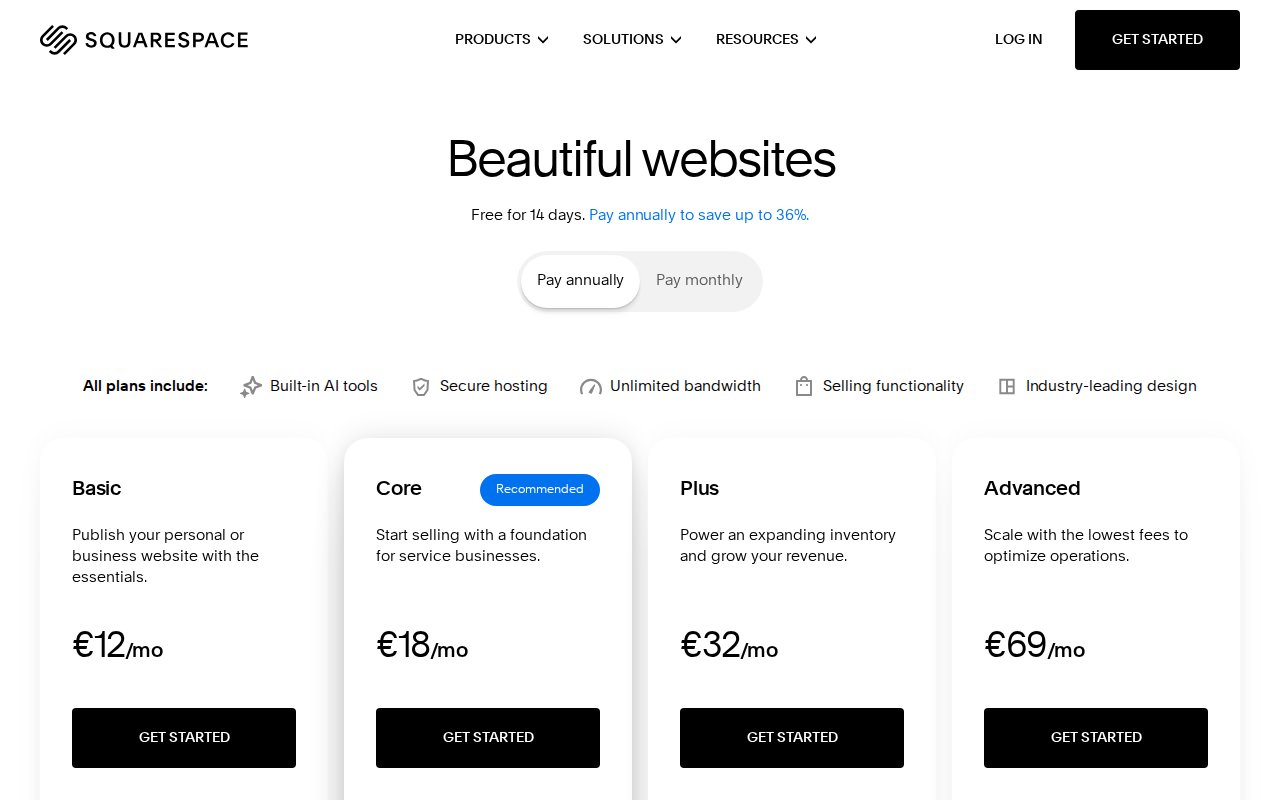 Squarespace’s pricing page — four tiers with annual billing.
Strengths:
- Best-in-class templates, consistently praised for design quality
- 0% platform transaction fees
- Blueprint AI builder for faster setup
- Email marketing, SEO, and analytics included
- Squarespace Payments supports multiple currencies; Stripe and PayPal also available
Limitations:
- Less e-commerce depth than dedicated platforms — fewer third-party integrations, more limited upsell and advanced automation options
- Not well-suited for large product catalogs or complex fulfillment workflows
- No dedicated dropshipping or AliExpress integration
What real users say
“Excellent customer support from a professional, knowledgeable, efficient, and caring support staff.”
— Craig, Trustpilot (November 19, 2026) (source)
“Chat only live support is subpar. Start taking phone calls.”
— Steve, Trustpilot (November 24, 2026) (source)
Squarespace is an excellent Shopify alternative when brand presentation matters as much as conversion optimization and your catalog stays manageable in size. If you’re deciding between Squarespace and Shopify specifically, see our detailed Squarespace vs Shopify comparison for a side-by-side breakdown.
7. PrestaShop: Best Open-Source Shopify Alternative for Complex Stores
Best for: merchants with specific technical requirements, complex catalog structures, or multi-language and multi-store setups who have developer resources or an agency relationship.
 PrestaShop homepage — positioning as an enterprise-grade open-source commerce solution.
PrestaShop was founded in 2007 by Bruno Lévêque and Igor Schlumberger from a student project. The Classic edition is free and open source; PrestaShop Hosted is a managed version available on request.
PrestaShop Classic (self-hosted):
- License fee: free (open source)
- Hosting: your responsibility — typically $15–$100+/month depending on store size
- Modules: the core is functional but most useful extensions cost $35 to several hundred dollars each
- Platform transaction fee: 0%
Strengths:
- 0% platform transaction fees
- Fully open source — complete control over code and data
- Strong multi-store and multi-language support natively
- Wide payment gateway compatibility (Stripe, PayPal, Klarna, Alma, and many regional providers)
- Scales well for complex B2B catalog structures
Limitations:
- Significant technical learning curve — expect to need developer support
- Paid modules drive the total cost up considerably beyond the “free” headline
- Self-managed: hosting, security patches, and updates are entirely your responsibility
What real users say
“I just love it.”
— Ivaylo, Trustpilot (October 19, 2025) (source)
“The PrestaShop software is free but essentially unusable without serious modifications and several commercial modules.”
— D. M., Trustpilot (March 31, 2025) (source)
PrestaShop is a strong choice for merchants who have the technical resources to manage it, need multi-store or complex B2B capabilities, and want 0% platform fees on a highly customizable foundation. It is not suitable for a quick, low-maintenance launch.
8. BigCommerce: Best Shopify Alternative for High-Volume Sellers
Best for: growing merchants and B2B operations who want 0% platform transaction fees, strong native catalog tools, and a platform they won’t outgrow as volumes increase.
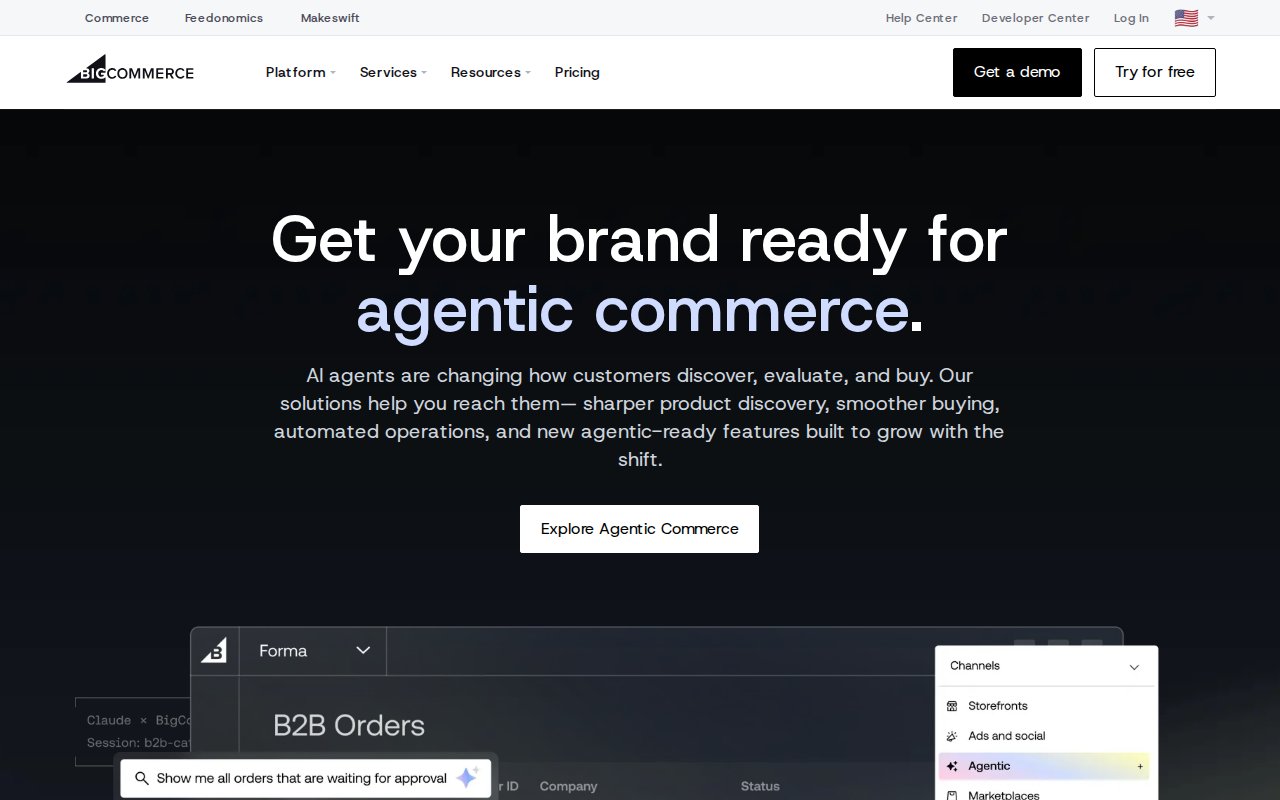 BigCommerce homepage — recently repositioned around “agentic commerce” and AI-driven growth.
BigCommerce was founded in 2009 in Sydney, Australia, by Eddie Machaalani and Mitchell Harper, with the goal of making serious e-commerce infrastructure accessible without a six-figure development budget. It is a publicly traded SaaS platform with particular strength in B2B, SEO, and multi-channel selling.
Plans and pricing (annual billing, USD):
| Plan | Monthly price (annual) | Platform fee |
|---|---|---|
| Core | ~$29/mo | 0% |
| Growth | ~$79/mo | 0% |
| Scale | ~$299/mo | 0% |
| Performance | From $1,499/mo | 0% |
BigCommerce is currently running a promotional offer of up to 50% off the first year — the screenshot below shows this.
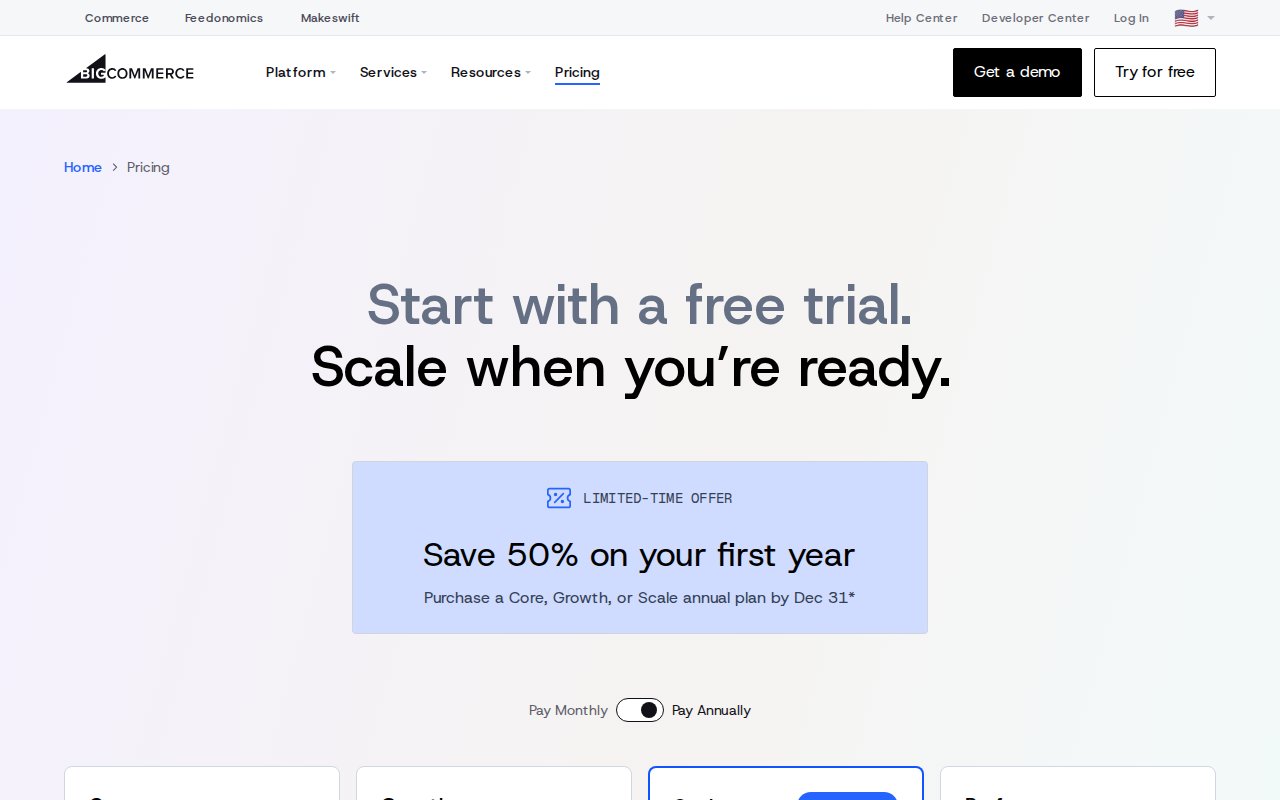 BigCommerce’s pricing page — currently offering up to 50% off for the first year.
Note that plans have annual GMV thresholds; exceeding the cap on a lower plan triggers an upgrade prompt. All prices are in US dollars — merchants in the UK, Australia, Canada, India, or the EU should account for the exchange rate.
Strengths:
- 0% platform transaction fees across all plans — a direct competitive advantage over Shopify
- Strong native catalog tools, B2B pricing hierarchies, and multi-channel integrations (Google, Meta, TikTok, Amazon, Walmart, eBay)
- 65+ built-in payment solutions, 130+ total options
- Headless commerce support via the Catalyst framework
- 15-day free trial
Limitations:
- GMV caps on lower plans require upgrades as your business grows
- More complex to set up than Wix or Squarespace
- Some features still require third-party apps
- USD billing exposes international merchants to exchange rate fluctuations
What real users say
“BigCommerce feels like a platform you grow into rather than out of.”
— Leslie, Trustpilot (September 26, 2026) (source)
“One day the scammers at BigCommerce work up and thought: ‘Do we have leverage to squeeze our customers’?”
— Arve, Trustpilot (September 24, 2026) (source)
“After being with this company for 12 years, they’re now charging small business 1% for offline transactions.”
— Ella, Trustpilot (September 17, 2026) (source)
BigCommerce is a compelling Shopify alternative for merchants whose primary concern is eliminating platform transaction fees and scaling their catalog without changing platforms as revenues grow.
9. How to Choose the Right Shopify Alternative: A Decision Guide
Match your profile to the platform that fits your actual situation:
| Your profile | Best platform | Why |
|---|---|---|
| Launching your first store, non-technical | Wix or Squarespace | Easiest setup, no coding required, polished results |
| Want everything included, no extra apps | Ekomspace | Email, reviews, upsells, SEO, AI service agent — all native from €39/mo |
| AI-first launch with all features built in | Ekomspace | AI builds the store; every tool is already included |
| Technical team, full flexibility and data ownership | WooCommerce or PrestaShop | 0% platform fees, open source, unlimited customization |
| Design is central to your brand identity | Squarespace | Best templates in market, solid commerce module |
| High GMV, 0% platform fees, B2B catalog | BigCommerce | No transaction fees, scales without penalty |
| Complex catalog, multi-store, multi-language | PrestaShop | Full open-source flexibility, multi-store native |
| Dropshipping via AliExpress, budget-conscious | Ekomspace Starter | AliExpress connection included; use code WELCOME for €1 first month |
| Already on Shopify, apps working, profitable | Stay on Shopify | Migration cost may outweigh the savings |
10. When Staying on Shopify Is Still the Right Choice
This guide exists to help you find the best Shopify alternative for your situation. But switching is not always the right move.
You have specific integrations with no equivalent elsewhere. Some proprietary ERP connections, logistics platforms, or niche B2B tools are deeply integrated with Shopify and would be difficult to replicate. If those integrations are business-critical, that changes the calculus.
Your current setup is profitable and you’re not in pain. If your monthly spend on apps is fully covered by the revenue they generate, the ROI of migrating may not justify the effort. Switching platforms takes real time and focus — that energy is often better spent growing the store you already have.
You rely heavily on Shopify’s developer ecosystem. With ~31,000 apps and a massive global community of Shopify-certified developers and agencies, Shopify offers a depth of specialized support that no other SaaS platform matches. For highly custom builds, that community advantage is real.
You need Shopify POS for a physical retail component. Shopify’s point-of-sale system is tightly integrated and well-established, particularly in the US, UK, Canada, and Australia. If your business runs both physical and online locations with tight inventory sync, evaluate POS alternatives carefully before moving.
You are on Shopify Plus. At that scale — multi-store support, dedicated account management, enterprise SLAs — the conversation is entirely different. The comparison in this article addresses standard plans.
The honest bottom line: Shopify is a solid, mature platform with a proven track record. If it is working for your business today and your margin holds up, the best alternative may simply be to stay.
11. How to Migrate from Shopify to Another Platform in Less Than a Day
The most important rule of any migration: 301 redirects must be configured correctly. This is non-negotiable if you want to preserve your SEO rankings. Every URL that changes without a redirect in place is a potential traffic loss — and recovering lost organic rankings can take months.
Migration checklist: Shopify to a new platform
Before you switch:
- Export your Shopify data — go to your Shopify admin and download your products, collections, customers, and orders as CSV files.
- Map your URL structure — list all current product and page URLs; identify which will change and what their new equivalents will be.
- Import on the new platform — most platforms support CSV import; Ekomspace also allows direct URL import from your live Shopify store.
- Configure 301 redirects — set up a redirect from every old URL to its new destination; this transfers link authority and prevents 404 errors for your visitors.
At launch:
- Test your checkout — place a complete test order end-to-end to confirm payment processing, confirmation emails, and order management all work correctly.
- Verify your integrations — check your Meta pixel, Google Analytics (GA4), Google Shopping feed, TikTok pixel, and all transactional email flows.
- Switch your DNS — point your domain to the new platform. DNS propagation typically takes 1 to 48 hours depending on your registrar and TTL settings.
SEO note: 301 redirects pass the accumulated link authority from your old URLs to the new ones. Skipping this step — even temporarily — can cause significant organic traffic loss that takes months to recover from. It is the single most important technical step of any platform migration.
Migrating to Ekomspace specifically
With Ekomspace, migration from Shopify is included in your subscription:
- Method 1 — URL import: paste your live Shopify store URL. Products, variants, collections, images, blog posts, and pages are imported automatically.
- Method 2 — CSV import: upload Shopify export files for customers and orders not covered by the URL method.
- Redirects: configured automatically — your old Shopify URLs redirect to the new Ekomspace URLs without manual work.
- Timeline: less than a day, end to end.
For WooCommerce or PrestaShop, migration is more involved: manual CSV import, manual or plugin-managed 301 redirects, payment gateway reconfiguration, and theme or template setup. Budget for meaningful developer time if you go that route.
Payment gateway availability by region
Before committing to any platform, verify that your payment gateways work where you sell:
- Stripe: 46+ countries, including the US, UK, Canada, Australia, Ireland, New Zealand, Singapore, UAE, India, Malaysia, Philippines, South Africa, and others. Check stripe.com/global for the complete list. Coverage in West Africa and the Caribbean is limited or still expanding.
- PayPal: available in 200+ markets globally — the most universally available option for merchants worldwide.
- Klarna: US, UK, Canada, Australia, Germany, the Netherlands, and select other markets.
- Apple Pay / Google Pay: broadly available wherever the underlying card is supported.
For merchants in markets with limited Stripe availability — including parts of Nigeria, Ghana, Jamaica, and Trinidad and Tobago — confirm payment gateway compatibility before choosing a platform and initiating a migration.
Conclusion
The best Shopify alternative in 2026 is not the same for everyone. It depends on your budget, your technical resources, your store’s volume, and what specifically is frustrating you about your current setup.
If your main pain point is a rising bill from stacking third-party apps — email marketing, customer reviews, upsells, SEO, order tracking — and you want one subscription that covers everything natively, Ekomspace is the most direct answer, starting at €39/month with no commitment. Its AI agents build your store, then keep working to generate sales: writing daily content, handling customer service, and managing your email marketing. Migration from Shopify takes less than a day, with redirects handled automatically.
If you need maximum technical flexibility and have the resources to manage an open-source stack, WooCommerce or PrestaShop are worth the complexity. If your brand’s visual identity is paramount and your catalog is manageable, Squarespace is hard to beat. For high-volume operations with zero tolerance for platform transaction fees, BigCommerce is built for it. And if you’re new to e-commerce and want the gentlest learning curve, Wix gets you selling fast.
If Shopify is working well for you today — stay. The goal is not to switch platforms; it is to run the most profitable store you can.
Create my store with Ekomspace →
FAQ — Best Shopify Alternatives in 2026
What is the best Shopify alternative in 2026?
The best Shopify alternative depends on your situation. Ekomspace suits merchants who want everything built in without an app store — email marketing, reviews, upsells, SEO, and an AI customer service agent are all native from €39/month. WooCommerce is ideal for technically resourced teams. BigCommerce is built for high-volume sellers with 0% platform fees. Squarespace works for design-led brands. Wix is the easiest starting point for beginners. Use the decision table in section 9 to match your profile to the right platform.
Is there a Shopify alternative that includes everything natively, with no app store?
Yes. Ekomspace includes email marketing (built in-house — not Klaviyo or Omnisend), customer reviews, one-click upsells, SEO tools, parcel tracking, an affiliate system, and an AI customer service agent — all native, in every plan, with no App Store required. Use code WELCOME to try your first month for €1 on any monthly plan.
Can I migrate from Shopify to another platform without losing my SEO rankings?
Yes, as long as 301 redirects are correctly configured. With Ekomspace, redirects are managed automatically during migration — your old Shopify URLs redirect to the new ones without any manual setup. The process takes less than a day: paste your Shopify store URL, or upload a CSV. For WooCommerce and PrestaShop, redirect setup is manual and requires technical input.
Which Shopify alternative charges no platform transaction fees?
WooCommerce, PrestaShop, Wix, Squarespace, and BigCommerce all charge 0% platform transaction fees. Ekomspace charges 2% (Starter), 1% (Pro), or 0.5% (Business) on top of your payment processor’s fees. Shopify charges between 2% and 0.6% when you use a third-party gateway instead of Shopify Payments.
Is WooCommerce really free as a Shopify alternative?
The WooCommerce plugin is free and open source, but the real cost includes hosting ($25–$350/month), extensions ($29–$299/year each), and payment processing (~2.5–2.9% + $0.30 per transaction). The annual total for a standard store typically runs $300–$800+, before accounting for any developer time for setup or ongoing maintenance.
What are the biggest drawbacks of Shopify compared to its alternatives?
Shopify’s main weaknesses are its dependence on paid third-party apps for essential functions — email marketing, reviews, upsells, advanced SEO — and transaction fees of up to 2% when you don’t use Shopify Payments. Shopify Payments itself is only available in around 41 countries, leaving merchants in India, most of Africa, and large parts of Latin America paying extra fees on every sale. That said, Shopify’s App Store (~31,000 apps), its global developer community, and its POS integration remain genuine competitive advantages that no other platform fully replicates today.
Which Shopify alternative works best for merchants in the UK, Australia, Canada, India, or Nigeria?
Most platforms in this comparison work globally. Stripe and PayPal are available in the UK, Australia, Canada, India, South Africa, Malaysia, Singapore, and the UAE. Shopify Payments covers the UK, Australia, Canada, New Zealand, Ireland, and Singapore. Ekomspace accepts Stripe, PayPal, Apple Pay, Google Pay, and Klarna. For merchants in markets where Stripe is not yet fully available — including parts of Nigeria, Ghana, Jamaica, and Trinidad and Tobago — verify payment gateway compatibility before choosing a platform and migrating.
Frequently asked questions
What is the best Shopify alternative in 2026?
The best Shopify alternative depends on your situation. Ekomspace suits merchants who want everything built in without an app store, from €39/month. WooCommerce fits technically resourced teams who need full control. BigCommerce works for high-volume sellers with zero platform transaction fees. Squarespace is a strong pick for design-first brands. Always compare total cost — base plan, apps, and transaction fees — not the subscription price alone.
Is there a Shopify alternative that includes everything natively, with no app store?
Yes. Ekomspace includes email marketing, customer reviews, one-click upsells, SEO tools, an AI customer service agent, and an AI blog agent natively — no app store to browse, no third-party tools to subscribe to. Everything is included from €39/month.
Can I migrate from Shopify to another platform without losing my SEO rankings?
Yes, provided 301 redirects are correctly configured. With Ekomspace, redirects are handled automatically during migration. You can paste your Shopify store URL or upload a CSV file, and the entire process takes less than a day.
Which Shopify alternative charges no platform transaction fees?
WooCommerce, PrestaShop, Wix, Squarespace, and BigCommerce all charge 0% platform transaction fees. Ekomspace charges 2% (Starter), 1% (Pro), or 0.5% (Business) on top of your payment processor's fees. Shopify charges between 2% and 0.6% if you use a third-party payment provider instead of Shopify Payments.
Is WooCommerce really free as a Shopify alternative?
The WooCommerce plugin is free and open source, but the real cost includes hosting ($25–$350/month), extensions ($29–$299/year each), and payment processing (~2.5–2.9% + $0.30 per transaction). Total annual costs typically run $300–$800+ for a standard store, not counting developer time.
What are the biggest drawbacks of Shopify compared to its alternatives?
Shopify's main drawbacks are its dependence on paid third-party apps for essential features like email marketing, customer reviews, upsells, and advanced SEO — which pushes the real monthly bill well above the base plan price. Transaction fees of up to 2% also apply when you don't use Shopify Payments, and Shopify Payments itself is only available in around 41 countries.
Which Shopify alternative works best for merchants in the UK, Australia, Canada, India, or Nigeria?
Most platforms in this comparison work globally. Stripe and PayPal are available in the UK, Australia, Canada, India, South Africa, Malaysia, Singapore, the UAE, and many other markets. Shopify Payments covers the UK, Australia, Canada, New Zealand, Ireland, and Singapore. Ekomspace accepts Stripe, PayPal, Apple Pay, Google Pay, and Klarna. For merchants in some African or Caribbean markets where Stripe is not yet available, verify local payment gateway compatibility before migrating.