
You have a product to sell and a brand to build — and two platforms that every guide, forum, and YouTube video keeps recommending. The squarespace vs shopify debate is one of the most searched comparisons in e-commerce, and for good reason: they target similar audiences but solve fundamentally different problems. Pick the wrong one and you will either pay for infrastructure you never use, or hit a hard ceiling just as your store starts to gain traction.
This article gives you the honest, 2026-verified answer to the squarespace vs shopify question. We compare Shopify vs Squarespace on current pricing, real features, honest limits, and word-for-word reviews from actual users — not marketing copy. We also introduce a third option worth knowing: Ekomspace, an AI-powered all-in-one platform where the store builds itself and essential tools come included natively, so you never need to stack paid apps on top.
By the end, you will know exactly which platform fits your situation — and what each one will actually cost you per month.
Squarespace or Shopify? The 30-Second Answer
Squarespace is the right call if design and brand aesthetics come first and you sell occasionally or run a small catalog. It starts cheaper, looks better out of the box, and requires almost no technical knowledge to launch a polished site.
Shopify is the right call if selling products is your entire business model. If you need serious inventory management, multi-channel selling (Amazon, TikTok Shop, in-person POS), and the ability to scale to hundreds of SKUs, Shopify’s infrastructure and app ecosystem are purpose-built for that.
Neither is the right fit if you want an AI-managed store with everything — email marketing, customer reviews, upsells, SEO, multi-currency — bundled under one predictable monthly price, without manually researching, subscribing to, and managing separate tools. That problem is what Ekomspace was built to solve; we cover it in full in its own section below.
Bottom line: Squarespace for design-first websites with a light product catalog. Shopify for serious product-first e-commerce. Ekomspace if you want one AI-powered platform that builds and operates your store — without the app bill.
Squarespace vs Shopify 2026: Side-by-Side Comparison Table
Prices verified November 2026. Both platforms rebranded their plan names in 2025–2026. Many comparison articles online still reference Shopify’s retired “Basic / Shopify / Advanced” tiers or Squarespace’s older naming — this table uses current, verified names throughout.
2026 Pricing at a Glance
| Squarespace | Shopify | |
|---|---|---|
| Plans available | Basic, Core (recommended), Plus, Advanced | Basic, Grow, Advanced, Plus |
| Entry plan — annual billing | Basic — $19/mo | Basic — $29/mo |
| Entry plan — monthly billing | Basic — $25/mo | Basic — $39/mo |
| Top standard plan — annual | Advanced — $99/mo | Advanced — $299/mo |
| Top standard plan — monthly | Advanced — $139/mo | Advanced — $399/mo |
| Enterprise tier | — | Plus — from $2,300/mo |
| Platform transaction fee | 2% on Basic / 0% on Core, Plus, Advanced | 0% with Shopify Payments; 2% (Basic), 1% (Grow), 0.6% (Advanced) with third-party processors |
| Card processing (native processor) | Standard processor rates (Stripe, PayPal…) | 2.9%+$0.30 (Basic), 2.7%+$0.30 (Grow), 2.5%+$0.30 (Advanced) via Shopify Payments |
| Free trial | 14 days, no credit card required | Available |
Feature Matrix: Who Wins Each Category?
| Category | Squarespace | Shopify | Winner |
|---|---|---|---|
| Ease of use | Drag-and-drop, design-first | Merchant dashboard, product-first | Squarespace (for content creators) |
| Design and templates | Award-winning, art-directed | Functional, fully customizable | Squarespace |
| E-commerce depth | Good for small catalogs | Unlimited SKUs, full inventory system | Shopify |
| App ecosystem | Smaller | ~31,000 active apps | Shopify |
| Built-in SEO | Solid | Solid | Tie |
| Multi-channel selling | Limited | Amazon, TikTok Shop, POS | Shopify |
| Customer support | 24/7 (all plans) | 24/7 (all plans) | Tie |
| Native AI tools | Design Intelligence | Shopify Sidekick | Tie |
| Point of sale (POS) | Limited (US only, via Square) | Yes (all plans) | Shopify |
| Dropshipping | Limited | Native (via DSers, Zendrop) | Shopify |
| Entry price | Lower ($19/mo annual) | Higher ($29/mo annual) | Squarespace |
Screenshots of both official pricing pages below confirm these numbers directly at the source.
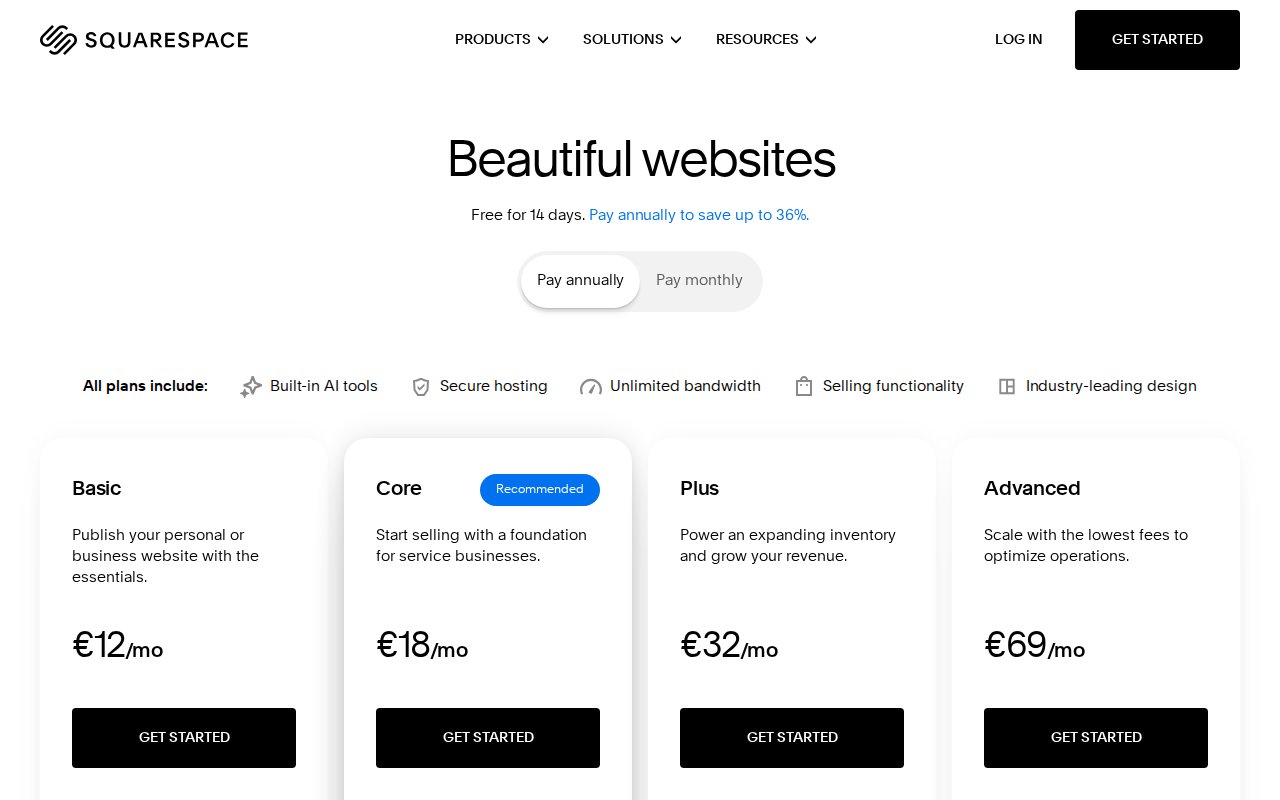 Official Squarespace pricing page — four current plans as of November 2026, with Core highlighted as the recommended default.
For comparison, here is Shopify’s own pricing page from the same period.
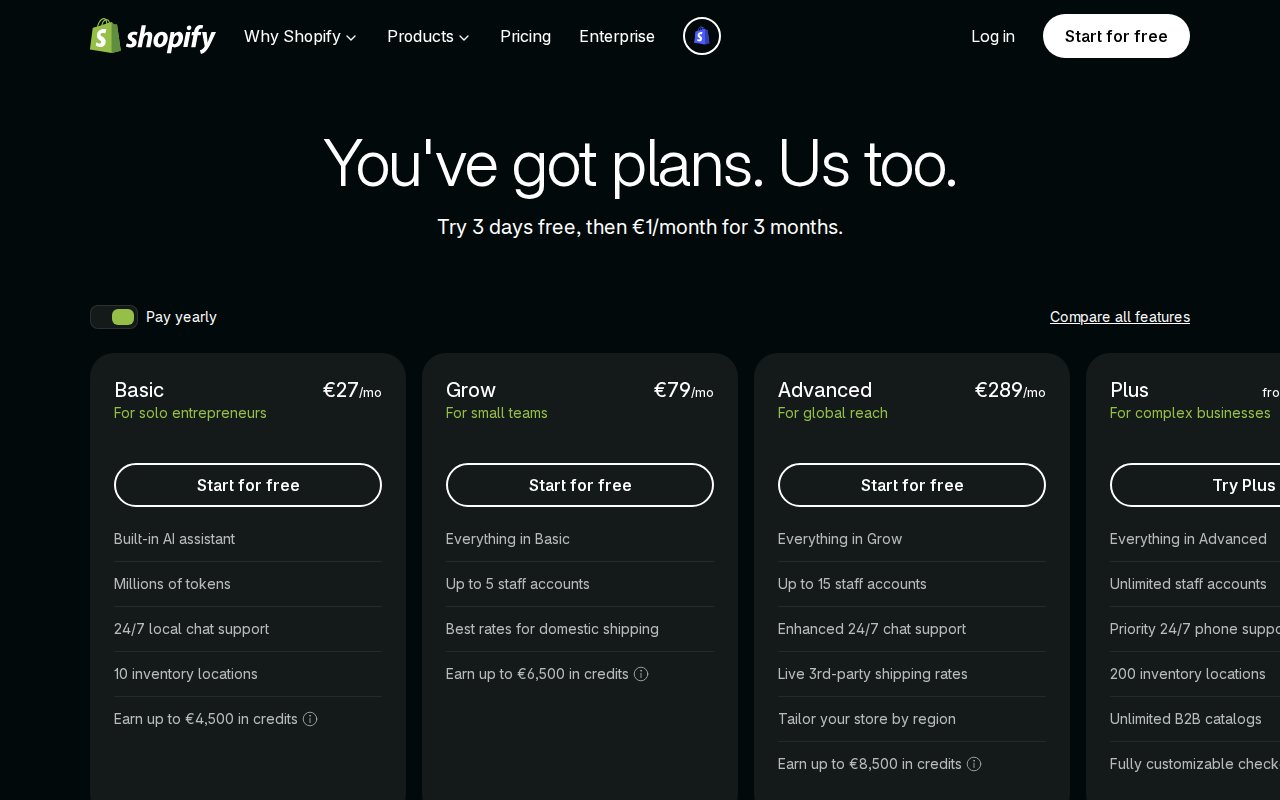 Official Shopify pricing page — four current plans as of November 2026, reflecting the 2025–2026 naming update.
Squarespace: Stunning Design, Real E-Commerce Limits
Direct answer: Squarespace is the best-looking platform in its price range and the most intuitive option for founders who care about visual storytelling. For selling, it performs well up to a small-to-medium catalog — but it hits real limits as transaction volume and product complexity grow.
Where Squarespace Genuinely Wins
Squarespace was founded in 2003 by Anthony Casalena, who built the first version in his dorm room at the University of Maryland with a $30,000 loan from his parents. That origin story matters: Squarespace was designed from day one to make professional-quality websites accessible to anyone, not just developers. Today the company employs over 1,760 people, with offices in New York, Dublin, and Portugal.
That founder DNA shows up in every corner of the product:
- Award-winning templates designed by professional art directors — not generic layouts assembled from a grid
- AI Design Intelligence included on all plans, helping you generate layouts, write copy, and style sections without touching code
- Powerful blogging and content engine — cleaner and more intuitive than Shopify’s built-in blog tools
- Secure hosting and unlimited bandwidth on every tier, including the entry-level Basic plan
- Free custom domain included with any annual subscription
- 14-day free trial with no credit card required
All Squarespace plans also include 24/7 customer support — not a given at this price point. The Core plan is Squarespace’s recommended default for most users, sitting between the entry-level Basic and the mid-tier Plus.
Best profile fit: photographers, coaches, service providers, agencies, lifestyle brands, and anyone running fewer than ~50 SKUs who needs a site that doubles as a portfolio or brand showcase.
Where Squarespace Falls Short for Product-First Stores
Squarespace’s e-commerce tools work, but selling products was never the platform’s core mission. The gaps become visible as you scale:
- Significantly smaller app and integration ecosystem compared to Shopify — fewer third-party tools to extend functionality
- No native multi-channel selling — you cannot list products directly on Amazon, eBay, or TikTok Shop through Squarespace
- Limited automation tools for high-volume merchants — no advanced order routing, fulfillment automation, or multi-warehouse support
- Basic plan carries a 2% Squarespace transaction fee on top of payment processor fees — this disappears on Core, Plus, and Advanced, but it matters for price-sensitive merchants just starting out
For merchants who need squarespace vs shopify for ecommerce to solve a serious sales volume problem, Squarespace’s ceiling becomes the deciding factor.
What Real Squarespace Users Say in 2026
Positive experiences consistently highlight the platform’s design quality and support responsiveness:
“I’m proud to have a long working relationship with Squarespace. I have 3 sites on the platform.” — Heather, Trustpilot (source), July 10, 2026
“At every interaction Squarespace has provided outstanding support. The patience and understanding shown by the Squarespace team” — James, Trustpilot (source), November 14, 2026
Negative feedback tends to surface around billing and account management friction:
“I would give them ZERO stars if I could. All I wanted to do is pay my annual domain registration invoice. Can’t talk to anyone.” — Elizabeth, Trustpilot (source), November 15, 2026
A pattern stands out: Squarespace wins on aesthetics and day-to-day support but frustrates users when billing or account management becomes the main interaction.
Curious to see how an AI-managed store compares in practice? Create my store on Ekomspace and explore a different approach to building an online store.
Shopify: Built for Selling — But What Does It Actually Cost Each Month?
Direct answer: Shopify is the most capable e-commerce engine available to small and medium businesses, with unmatched app depth, native POS, and a checkout Shopify claims converts 15% better on average. The real question is not whether Shopify can do something — it almost always can. The question is what that capability costs once you add the apps your store actually needs to operate.
What Shopify Does Best
Shopify was founded in 2006 by Tobias Lütke, Daniel Weinand, and Scott Lake. The origin story is well known in e-commerce: in 2004, the founders tried to sell snowboard equipment online through an existing platform, found it unusable, and built their own. That platform became Snowdevil, then Shopify.
Today, Shopify’s product-first focus is built into everything it ships:
- Unlimited products on every plan — no catalog size limits regardless of tier
- Shopify Sidekick — an AI assistant embedded in the admin, helping with product descriptions, campaign ideas, and store decisions
- ~31,000 active apps in the Shopify App Store (31,075 as of October 2026, per AppStorePulse) — email marketing, reviews, upsells, page builders, loyalty programs, and virtually anything else
- Native POS on all plans — sell in person with the same inventory and customer data synced automatically
- Dropshipping-ready — native integrations with DSers and Zendrop make product sourcing straightforward
- Multi-channel selling — list on Amazon, TikTok Shop, and Google Shopping directly from your Shopify admin
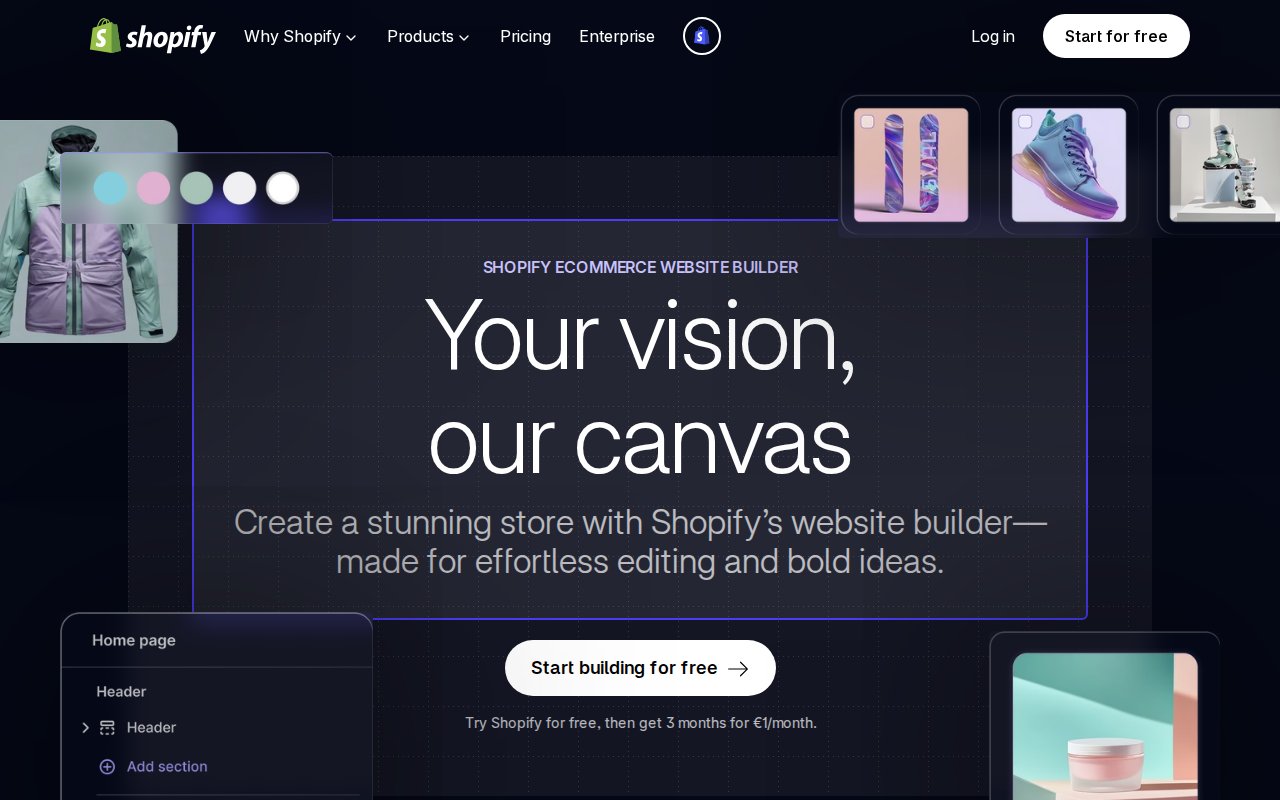 Shopify’s website builder landing page — the store editor gives merchants full control over design and product display.
The Real Monthly Cost Once You Add Essential Apps
Here is where shopify vs squarespace gets more complicated than the base pricing suggests.
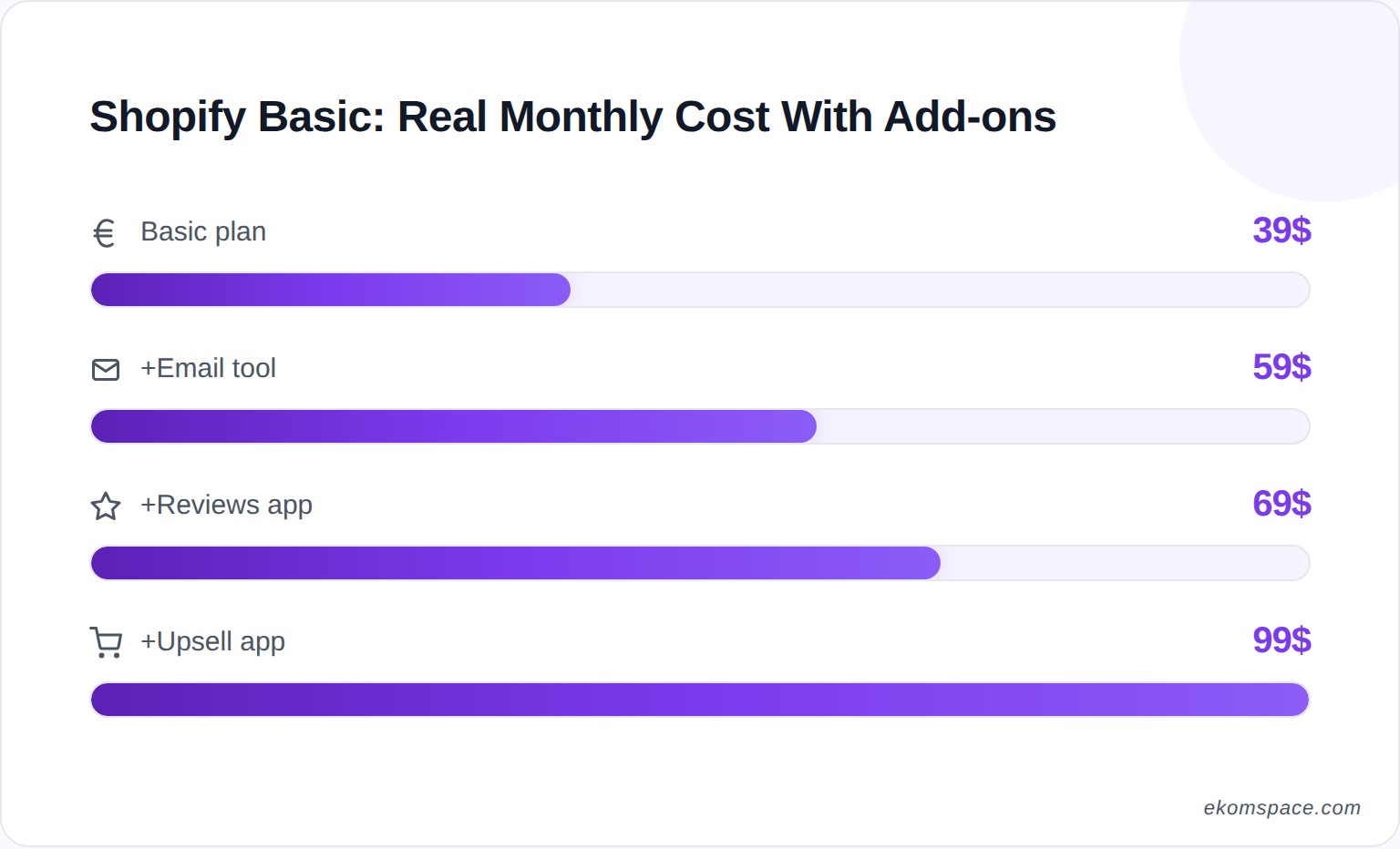
Shopify’s Basic plan starts at $29/mo (annual billing) or $39/mo month-to-month. But Shopify’s power comes from its app ecosystem — and apps cost money on top of the subscription.
A typical small Shopify store frequently requires:
- An email marketing platform (Klaviyo, Omnisend, or similar)
- A customer reviews app (Judge.me, Loox, or similar)
- An upsell or post-purchase offer app (ReConvert, AfterSell, or similar)
For example, if a merchant on Basic adds those three tools at their standard starting prices, their monthly spend rises materially above the $29 base. This is an illustrative scenario — not a stated average — but it reflects a pattern many Shopify merchants encounter when they look back at their monthly app invoices six months into running a store.
Transaction fee structure if you are not using Shopify Payments:
| Plan | Additional transaction fee |
|---|---|
| Basic | 2% per sale |
| Grow | 1% per sale |
| Advanced | 0.6% per sale |
| Plus | 0.2% per sale |
These fees stack on top of your payment processor’s own fees. If you are in a market where Shopify Payments is available (US, UK, Canada, Australia, New Zealand, Ireland, Singapore, and others), you can eliminate this additional fee and pay only Shopify’s card processing rates:
- Basic: 2.9% + $0.30 per online transaction
- Grow: 2.7% + $0.30 per online transaction
- Advanced: 2.5% + $0.30 per online transaction
For merchants in markets where Shopify Payments is not available, the additional transaction fee applies on every sale.
What Real Shopify Users Say in 2026
Recent Trustpilot reviews point to a consistent pattern: the product works, but commercial decisions by the company frustrate merchants:
“Shopify’s shameless cash grab, announced 10 days before Black Friday…” — Ben, Trustpilot (source), November 18, 2026
“It took THREE HOURS to cancel a $39 monthly subscription.” — Gary, Trustpilot (source), November 12, 2026
“My store has functioned properly only about one-third of the time…” — Ruth, Trustpilot (source), November 14, 2026
The technical platform is widely considered capable and reliable at scale. The frustration tends to cluster around fee changes announced with little notice and account management difficulties — a recurring theme in recent reviews.
For a broader view of what else is available, see our guide to more Shopify alternatives.
The Hidden Fees Nobody Totals Up: True Monthly Cost
Direct answer: Neither platform is “cheap” once you model out what a real operating store actually requires. The base subscription price is a floor, not a ceiling — and the gap between the two platforms depends heavily on what you need to sell.
No article in the current top search results breaks down the full app-stack cost with specific current tool prices. This section fills that gap.
Squarespace’s Real Cost Structure
For most small-to-medium stores, Squarespace’s cost structure is simpler and more predictable:
- Core, Plus, and Advanced plans carry zero Squarespace transaction fees — you pay only the payment processor (Stripe, PayPal, etc.)
- Most e-commerce features are built in — no separate app needed for basic email, SEO, or blogging
- The tradeoff: Squarespace’s native e-commerce ceiling is lower, so when you outgrow its built-in tools, there are fewer third-party options available to add
For a small-volume store on Squarespace Core (annual billing), the monthly cost is essentially the subscription plus payment processor fees — full stop. That predictability is a genuine advantage for founders who want to know their exact platform overhead from month one.
Shopify’s App-Stack Reality
For the squarespace vs shopify for ecommerce question around total cost of ownership, Shopify’s app-dependent model deserves honest scrutiny.
A Shopify store that needs professional email marketing, customer review collection, upsell flows, and a customized checkout is running four or more paid tools on top of the base subscription. Each tool adds a monthly line item — and those line items are recurring, independent subscriptions that do not disappear when your revenue dips.
For example, if a Shopify Basic merchant on the annual plan adds:
- A professional email marketing tool
- A customer reviews app
- An upsell/order bump app
…their actual monthly spend is materially higher than $29. This is a hypothetical illustration, not a claimed average — but it represents a pattern many merchants encounter when they model their true monthly costs.
Both platforms charge independent payment processor fees — neither is free to sell on. The question is how much of your additional monthly spend goes to platform apps versus tools that come included in the subscription.
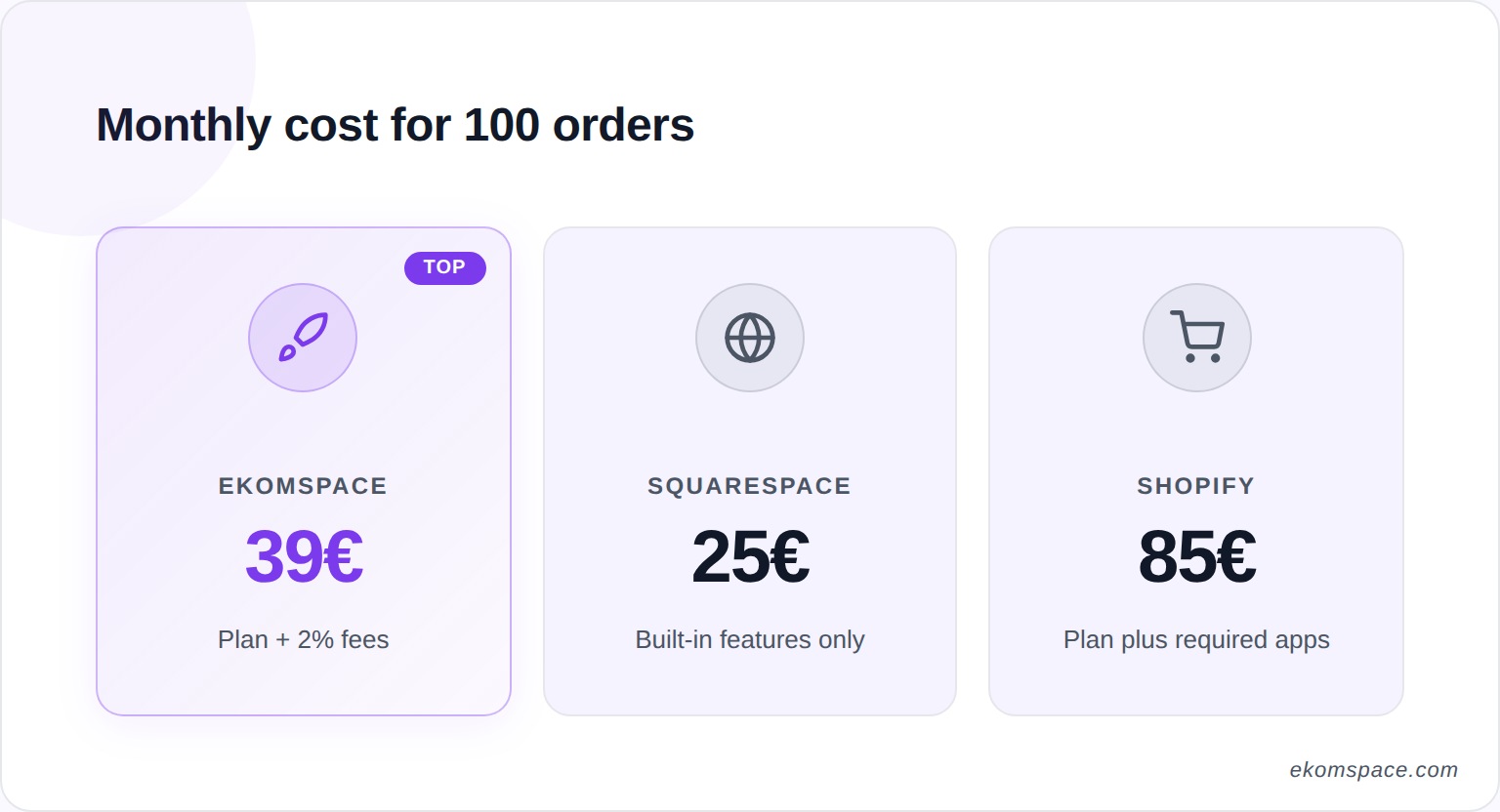
How the Three Platforms Compare on Cost Transparency
| Squarespace Basic (annual) | Shopify Basic (annual) | Ekomspace Starter | |
|---|---|---|---|
| Base price | $19/mo | $29/mo | €39/mo |
| Email marketing | Add-on | Add-on | Included |
| Customer reviews | Add-on | Add-on | Included |
| Upsells and order bumps | Add-on | Add-on | Included |
| SEO tools | Built-in | Built-in | Built-in |
| Multi-currency | Limited | App required | Included |
| Platform transaction fee | 2% (Basic) / 0% (Core+) | 0% (Shopify Payments) / 2% (third-party) | 2% |
| AI store builder | Design tools | Sidekick assistant | Full AI generation + chat |
Squarespace and Shopify prices in USD. Ekomspace prices in EUR. Payment processor fees always apply on all three platforms.
Ekomspace: The AI-Powered Third Option That Includes Everything
Direct answer: Ekomspace is an AI-powered e-commerce platform where the AI generates your store and modifies it by chat — and separate AI agents autonomously handle email marketing, customer support, and blog content on your behalf. Everything a typical Shopify merchant would pay for in separate apps comes included natively under one monthly price.
How Ekomspace Works
The fundamental difference between Ekomspace and both Squarespace and Shopify is the role AI plays in operating the store — not just building it.
Here is what that means in practice:
Building and editing your store:
- AI builds your store — describe your brand and products; the AI generates a complete, styled storefront
- Modify anything by chat — want to change the layout, add a new section, or update your homepage headline? Chat with the AI and it makes the change
AI agents running your store day to day:
- AI blog agent — writes SEO-optimized articles daily according to a full content strategy, targeting both Google and AI search engines — no manual writing required from you
- AI customer support agent — a chat assistant on your store that answers customer questions, handles “where is my order?” inquiries with real tracking data, and escalates to a human via the Ekomspace mobile app
- Email marketing included natively — campaigns, transactional emails, and automations (including abandoned cart) are managed in Ekomspace’s own built-in tool — no third-party email platform required
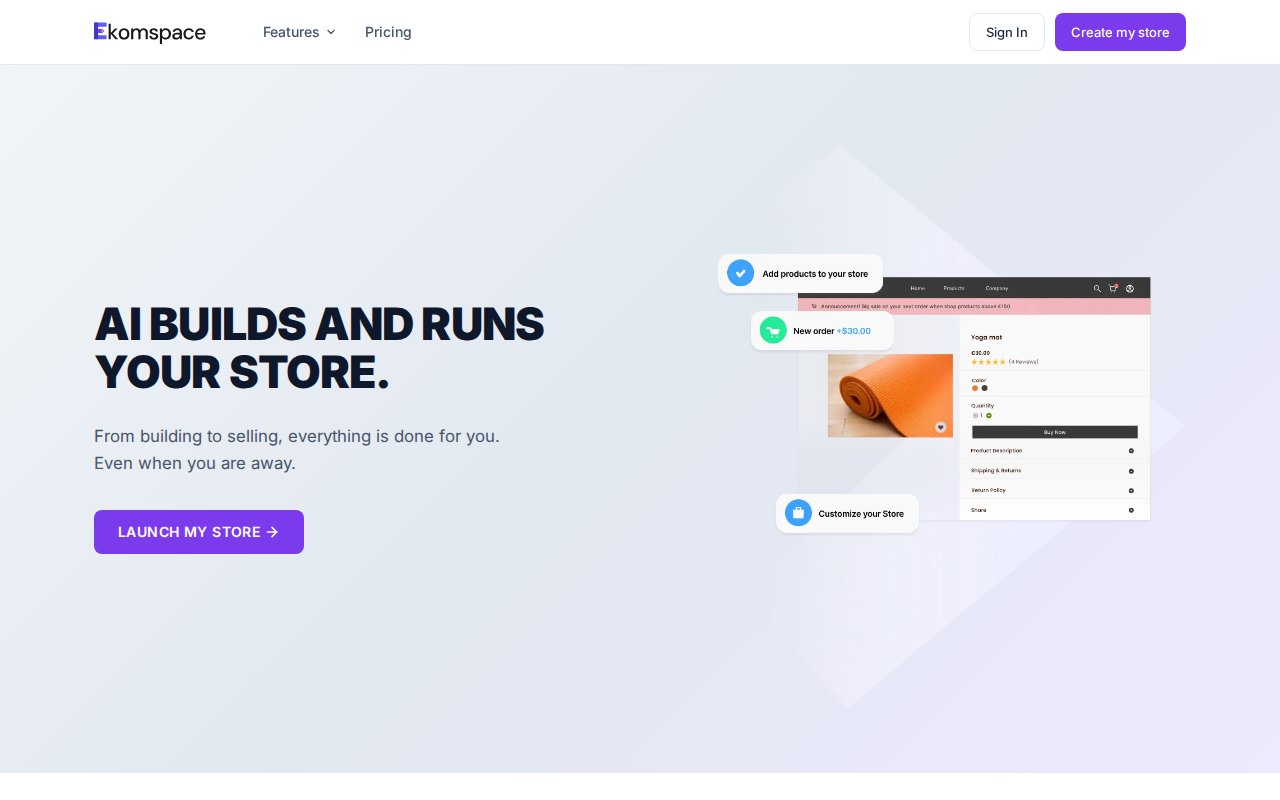 Ekomspace homepage — the AI-powered all-in-one e-commerce platform.
What Is Included Natively on Every Plan
No app store. No integrations to manage. Everything below is built in and included in your subscription:
- Email marketing — campaigns, automations, transactional emails, abandoned cart sequences
- Customer reviews — collection, management, and display (comparable to Judge.me or Loox)
- One-click upsells and order bumps
- SEO — meta tags, automatic sitemap, schema markup, image optimization
- Multi-currency — all currencies supported on all stores
- AI blog agent — daily articles per your content strategy (AI credits consumed per article)
- AI customer support agent — 24/7 store chat with real order and tracking data
- Affiliate program system
- Order tracking
- GDPR cookie banner
- Google Merchant Center feed
- Tracking pixels — Meta (with server-side Conversions API), Google Ads, TikTok, GA4
Ekomspace Pricing (November 2026)
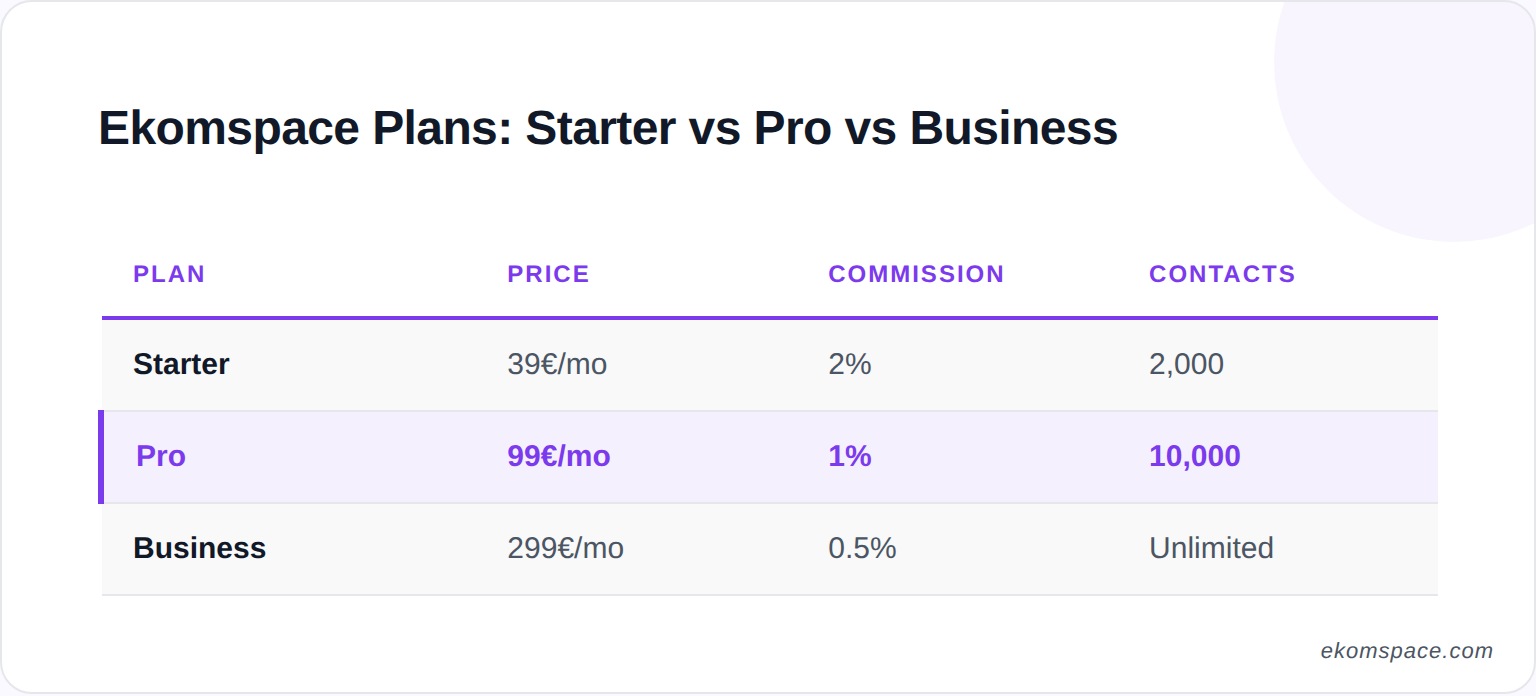
All prices in EUR. Ekomspace does not have a native payment processor equivalent to Shopify Payments, so the platform commission always applies on top of your payment processor fees — this is an honest difference worth knowing.
| Plan | Monthly price | Commission | Products | Contacts |
|---|---|---|---|---|
| Starter | €39/mo | 2% | 500 | 2,000 |
| Pro (recommended) | €99/mo | 1% | Unlimited | 10,000 |
| Business | €299/mo | 0.5% | Unlimited | Unlimited |
Annual billing is available: 12-month subscriptions (2 months included) bring Starter to €32/mo; 24-month subscriptions (6 months included) bring Starter to €29/mo.
Migrating from Shopify or Squarespace
If you are currently on Shopify or Squarespace and want to switch, the process is significantly faster than most merchants expect:
- From Shopify: paste your store URL directly into the Ekomspace import tool — products, variants, collections, images, and blog articles are imported automatically. Alternatively, upload a CSV file. Customers and order history can also be imported via CSV.
- From Squarespace: import your content via CSV export from your Squarespace account
- URL redirects are handled automatically — your existing search rankings are protected from day one
- Full migration completes in less than a day — the process is not spread over several days or weeks
The Honest Caveat
Ekomspace is a newer brand with a smaller ecosystem than Shopify’s 31,000-app marketplace or Squarespace’s established third-party integrations. If your business depends on dozens of niche third-party tools with no Ekomspace equivalent today, you will feel that gap. The tradeoff: everything Ekomspace does natively eliminates the monthly app fees, the management overhead, and the compatibility issues that come with running a stack of separate tools.
Ready to see it in action? Create my store and have an AI build your storefront today.
For a broader view of what platforms are available, see our guide to the best platform for small business.
Which Platform Fits Your Profile?
| Your situation | Best platform | Why |
|---|---|---|
| Design and brand presentation matter most; small catalog or services | Squarespace | Lowest entry price, award-winning templates, no app complexity |
| Selling products is your core business; need POS or multi-channel | Shopify | Deepest e-commerce engine, largest app ecosystem, native POS |
| Want all core tools included natively, predictable pricing, AI-run store | Ekomspace | Email, SEO, reviews, upsells — all included; AI agents handle daily operations |
| Migrating from Shopify and want to be live quickly | Ekomspace | URL import, automatic redirects, migration in less than a day |
| Need to sell across Amazon and TikTok Shop today | Shopify | Native multi-channel integrations not yet available on Ekomspace |
| Lowest possible monthly base price | Squarespace | Basic annual plan starts at $19/mo |
Choose Squarespace if…
- Design and brand presentation are your top priority
- You have a small product catalog or sell services alongside physical goods
- You want a lower entry price without deep e-commerce automation
- A polished portfolio or content-driven site is as important as the shop itself
- You are a photographer, coach, freelancer, or agency launching your first site
Choose Shopify if…
- Selling products is your core business model
- You need POS, dropshipping, or multi-channel selling (Amazon, TikTok Shop)
- You plan to scale to hundreds or thousands of SKUs
- You are willing to manage and pay for a stack of best-in-class apps to match your exact workflow
Choose Ekomspace if…
- You want an AI-managed store with no app complexity
- You need email, SEO, reviews, and multi-currency under one predictable monthly price
- You are migrating from Shopify or Squarespace and want to be live in under a day
- You want AI agents to handle your blog, customer support, and email automations on autopilot — without manually setting up separate tools
Explore more Shopify alternatives if neither of the above profiles fits your situation precisely.
Ready to stop paying for a stack of apps?
Whichever way the squarespace vs shopify decision goes for you, there is a third option worth trying before you commit. Create my store on Ekomspace and get an AI-built, all-in-one store live today.
Conclusion
The squarespace vs shopify comparison comes down to a single foundational question: is your site primarily a brand presence that happens to sell, or is selling the entire purpose of the site?
Squarespace is the right choice when design integrity matters most and your catalog stays small. It starts cheaper, requires less technical management, and produces a more polished default result for content-driven businesses. Its limits show when you need serious e-commerce infrastructure.
Shopify is the right choice when selling at scale is the goal. It has the deepest product catalog management, the largest app ecosystem, and the most native multi-channel options. The real monthly cost — once you model your app stack — is higher than the base price suggests, but for merchants who need that depth, the investment is justified.
Ekomspace is the right choice when you want the operational simplicity of an all-in-one platform with AI handling the work that would otherwise require three or four separate monthly subscriptions. It is a newer brand with a smaller ecosystem, but everything it does natively — email marketing, reviews, upsells, SEO, AI content, AI customer support — eliminates the overhead that makes Shopify expensive to run well.
Whatever side of the squarespace vs shopify debate you land on, make sure you are pricing in the full monthly cost, not just the subscription sticker price.
Create my store and see what an AI-managed store looks like in practice.
FAQ — Squarespace vs Shopify
Is Squarespace cheaper than Shopify in 2026?
Squarespace starts at $19/mo on the annual Basic plan, compared to $29/mo for Shopify Basic annual — so yes, Squarespace has a lower entry price. However, Shopify’s app ecosystem means most growing stores add email marketing, reviews, and upsell tools on top of the base price, which narrows or eliminates that gap. For small-volume stores that do not need deep e-commerce automation, Squarespace is the more affordable option.
Which is easier to use for beginners — Shopify or Squarespace?
Squarespace is generally more intuitive for non-sellers and content-first users. Its drag-and-drop editor is designed around visual thinking and brand aesthetics. Shopify’s admin is optimized around product and order management — it feels more natural to merchants whose daily priority is processing orders and managing inventory, but it can feel complex for someone building their first website with no e-commerce background.
Can you sell on Squarespace without paying transaction fees?
Yes — on Squarespace Core, Plus, and Advanced plans, Squarespace charges no platform transaction fees. Only the Basic plan carries a 2% Squarespace transaction fee on each sale. Standard payment processor fees (Stripe, PayPal, etc.) always apply regardless of which plan you are on.
How long does it take to move a Shopify store to a different platform?
Moving to Ekomspace from Shopify takes less than a day: paste your Shopify store URL into the import tool and products, variants, collections, images, and blog articles are imported automatically. URL redirects are handled automatically to protect your existing search rankings. Customers and orders can be imported via CSV. The process is not spread over several days.
What is the best all-in-one e-commerce platform for a small business just starting out?
It depends on your priority. If design and a low entry price matter most, Squarespace Basic is a strong start. If e-commerce depth matters most, Shopify Basic is the standard choice. If you want AI to build and operate your store — with email marketing, SEO, reviews, and customer support all included natively under one monthly price — Ekomspace Starter at €39/mo is built for exactly that use case. For a broader comparison across more platforms, see our guide to the best platform for small business.
Frequently asked questions
Is Squarespace cheaper than Shopify in 2026?
Squarespace starts at $19/mo on the annual Basic plan vs $29/mo for Shopify Basic annual — so yes, Squarespace has a lower entry price. However, once you factor in Shopify's larger app dependency vs Squarespace's more self-contained feature set, the total monthly cost gap can narrow significantly for small-volume stores.
Which is easier to use for beginners — Shopify or Squarespace?
Squarespace is generally more intuitive for non-sellers and content-first users. Shopify's admin is optimized around product and order management, making it more natural for merchants whose primary daily task is managing inventory and fulfilling orders.
Can you sell on Squarespace without paying transaction fees?
Yes — on Squarespace Core, Plus, and Advanced plans, Squarespace charges no platform transaction fees. Only the Basic plan carries a 2% Squarespace transaction fee. Standard payment processor fees (Stripe, PayPal, etc.) always apply regardless of plan.